Consulting Website Examples & Design Tips for Solo Consultants
Dec 24, 2025
Estimated Reading Time: 31 minutes
Download the article as a PDF:

Table of contents
- What you will learn in this article
- Why your consulting website matters for trust and deal flow
- What makes a great consulting website?
- Independent consultant sites vs. larger firm sites: what actually changes
- 5 best consulting website examples and why they work
- Standout design patterns from top consulting websites
- Essential elements and best practices for consulting website design
- How to build your independent consultant website
- Frequently asked questions from independent consultants
- Get the help you need to grow your independent consulting business the right way
What you will learn in this article
If you are an independent consultant or small firm owner, your website is doing far more than “existing online.” It is shaping how prospects understand your expertise, how much they trust you, and whether they feel confident taking the next step. This article breaks down what actually makes consulting websites effective, using real consulting website examples and practical design principles you can apply without overengineering.
Many consultants come to this topic feeling frustrated. Their site feels vague, generic, or overly complex. It does not reflect the quality of their work, and it does not help pre-sell their value before a conversation. Often, the issue is not aesthetics, it is that the site lacks clear jobs for each section to do.
This article is designed to solve that problem. You will learn how strong consultant websites are structured, what elements matter most, and how design, messaging, and trust signals work together to support buyer confidence and deal flow.
The guidance here is based on years of advising independent consultants on positioning, pricing, and growth. I have seen how tightening a hero message, reframing services, or adding the right trust signals can materially improve lead quality and shorten sales cycles. Throughout the article, I will also share patterns that consistently resonate with experienced buyers, so you can make decisions that support long-term growth, not just a quick refresh.
Why your consulting website matters for trust and deal flow
Your consulting website is often the first serious evaluation point for a potential client. Even when someone comes via referral, they will almost always review your site before booking a call. What they see there influences whether they feel confident, uncertain, or quietly hesitant.
A strong online presence creates buyer confidence by reducing ambiguity. Clear messaging, professional design, and visible trust signals reassure prospects that you are credible, experienced, and intentional about how you run your business. A weak or outdated site does the opposite, it introduces doubt and increases perceived risk.
Consulting website credibility directly impacts deal flow. When your site clearly communicates who you help, what outcomes you deliver, and how working with you feels, prospects arrive more aligned. That alignment leads to better conversations, fewer pricing objections, and faster decisions.
How your site supports positioning, pricing, and referrals
Your website is one of your strongest positioning assets. Strategic messaging on your homepage and services pages makes your specialization visible and reinforces your point of view.
This positioning work supports value-based pricing. When outcomes, process, and expertise are clearly articulated, your fees feel logical rather than arbitrary. The site does part of the justification before you ever say a number.
Referrals also convert more easily when your website reinforces your reputation. A well-structured site validates the referral source and helps the buyer understand why you are different from other consultants they could call.
What makes a great consulting website?
Great consulting websites are designed with intention. Every section has a job to do, and nothing exists just to fill space.
Clear messaging ensures visitors immediately understand who the site is for and why it matters. Conversion-focused design guides them toward a next step without pressure. Professional branding and user experience create a sense of stability and competence.
The best consultant websites also show restraint. They prioritize clarity over cleverness and depth over volume. Thought leadership content is used to reinforce expertise, not overwhelm the reader.
The essential elements of effective consulting website design
Effective consulting website design starts with a clean layout and intuitive navigation. Visitors should be able to find core information without thinking.
Responsive design ensures the site works across devices, while visual hierarchy directs attention to what matters most, typically your value proposition, services, and calls to action.
Consistent branding across colors, typography, and imagery signals professionalism. These details quietly reinforce trust and consulting website credibility.
Features that top consultant websites share
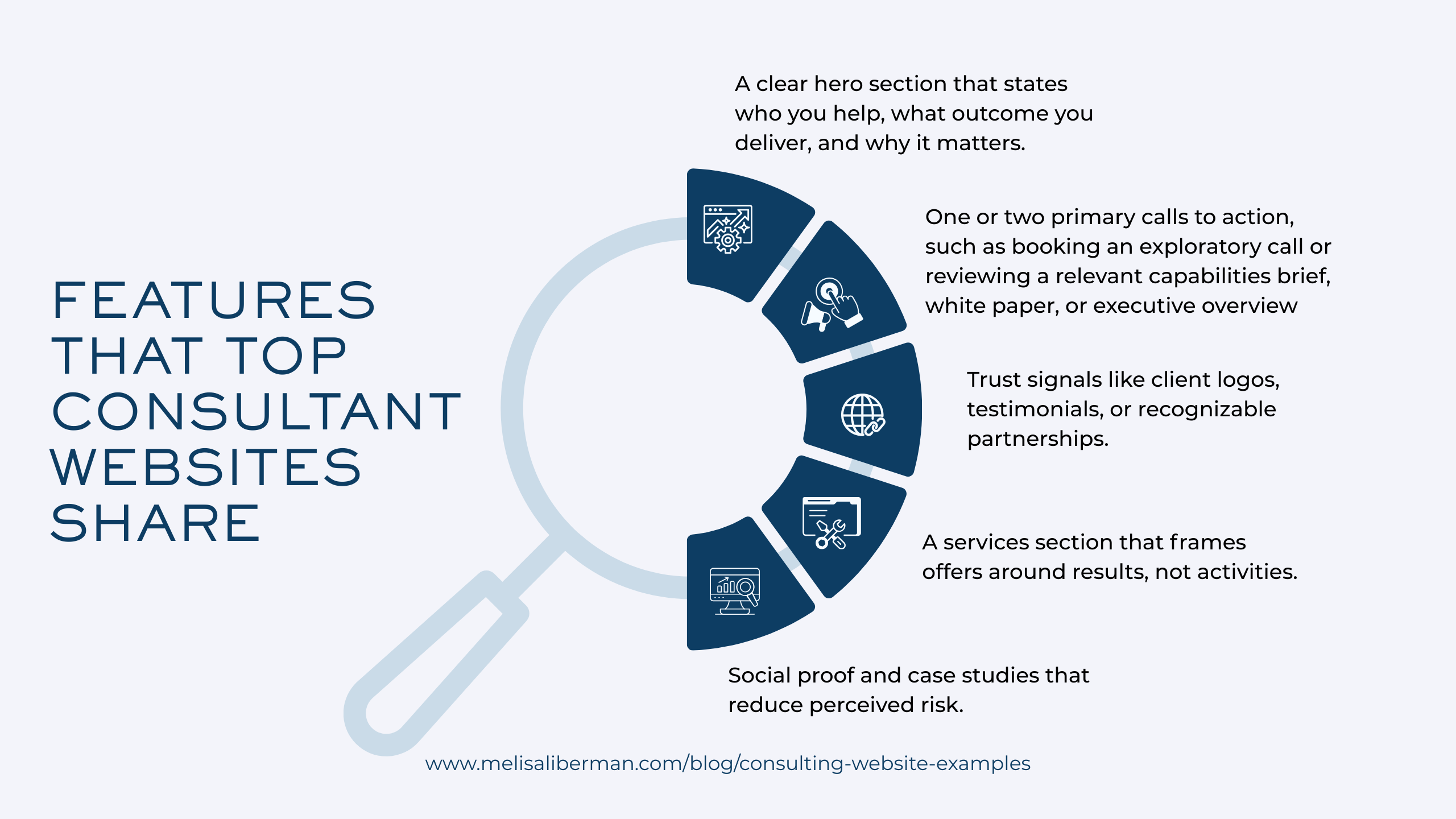
High-performing consulting websites consistently include:
- A clear hero section that states who you help, what outcome you deliver, and why it matters.
- One or two primary calls to action, such as booking an exploratory call or reviewing a relevant capabilities brief, white paper, or executive overview
- Trust signals like client logos, testimonials, or recognizable partnerships.
- A services section that frames offers around results, not activities.
- Social proof and case studies that reduce perceived risk.
Each of these features supports a specific buyer question, rather than trying to impress with volume.
Independent consultant sites vs. larger firm sites: what actually changes
Independent consultant websites differ from larger firm sites in meaningful ways. Personal branding is central, not optional. Your perspective, experience, and approach are core assets.
Solo consultants and boutique consultancies also benefit from customization flexibility. You can update messaging quickly, refine positioning, and adapt content as your business evolves.
Larger firm sites often emphasize scale and breadth. Independent consultants win by emphasizing focus, clarity, and relevance.
Why design signals credibility and reduces perceived risk
Design choices directly influence perceived risk. Professional web design, visual consistency, and thoughtful UX design reassure buyers that you operate with care and discipline.
Credibility indicators like testimonials, polished layouts, and intentional spacing signal that you are established and reliable, even as a solo consultant.
How solo consultants use their websites for marketing and lead generation
For many solo consultants, the website serves as the central marketing hub. SEO for consultants drives inbound interest, while content marketing builds authority over time.
Email opt-ins, buyer resources, and clear inquiry paths allow you to nurture relationships without constant outbound effort. The site supports marketing, rather than requiring it.
5 best consulting website examples and why they work
When people search for consulting website examples, they are rarely looking for inspiration alone. They are looking for proof of what “good” actually looks like in practice.
The strongest consultant websites are not defined by aesthetics or trends. They work because each page and section is designed to answer a specific buyer question, reduce uncertainty, and reinforce credibility. The following examples are anonymized on purpose. What matters is the pattern, not the personality behind it.
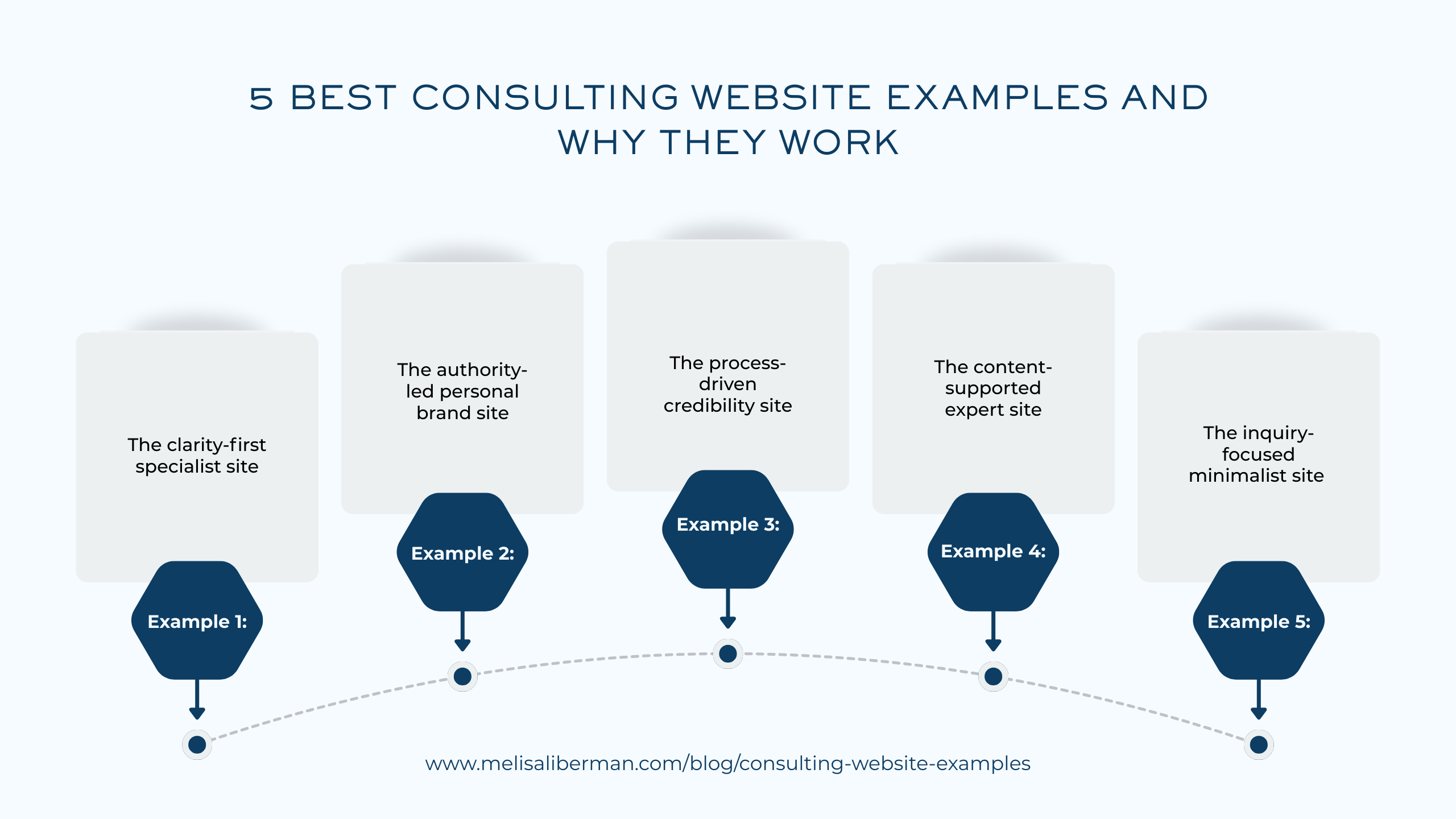
Example 1: The clarity-first specialist site
This site works because the positioning is immediately obvious. The hero section clearly states who the consultant helps, the core problem they solve, and the outcome clients can expect.
There is no generic language or long-winded explanation. The services section reinforces the same message, framing offerings around results rather than deliverables. Calls to action are limited and clearly named, which reduces friction and sets expectations.
Why it works:
- Clear audience and outcome alignment
- Consistent messaging across pages
- Simple, confident calls to action
Example 2: The authority-led personal brand site
This example stands out because it leans into personal branding without becoming self-centered. The consultant’s perspective and experience are woven throughout the copy, especially on the about and services pages.
Trust signals are integrated naturally through short testimonials, recognizable client categories, and evidence of experience, rather than long case studies. The site feels credible without trying to impress.
Why it works:
- Strong point of view without overexplaining
- Subtle but effective trust signals
- Messaging that supports premium positioning
Example 3: The process-driven credibility site
This site excels at reducing perceived risk. A clearly articulated “How it works” section walks the buyer through the engagement process in simple, outcome-focused language.
By setting expectations upfront, the site builds confidence before any sales conversation happens. The design supports this clarity with clean layouts and strong visual hierarchy.
Why it works:
- Transparent process explanation
- Reduced buyer anxiety
- Design that reinforces professionalism
Example 4: The content-supported expert site
This example uses thought leadership strategically. Educational content supports the consultant’s positioning without overwhelming the visitor or turning the site into a blog archive.
Articles, guides, or resources are clearly tied back to the services offered, reinforcing expertise while still driving inquiries.
Why it works:
- Content reinforces services instead of distracting from them
- Strong alignment between expertise and offers
- SEO-friendly without feeling salesy
Example 5: The The inquiry-focused minimalist site
This site is intentionally minimal. It limits choices, reduces navigation complexity, and focuses attention on one primary action.
Rather than trying to answer every question at once, it guides the visitor through a logical flow: clarity first, trust second, action third. This makes it especially effective for referrals and warm traffic.
Why it works:
- Fewer distractions, stronger more qualified inquiries
- Clear hierarchy of information
Design and messaging working together
Standout design patterns from top consulting websites
Many high-performing consulting websites use asymmetrical layouts and full-width imagery to create visual interest without clutter.
Microinteractions, persistent calls to action, and modular content blocks improve usability while keeping the experience calm and professional. These patterns support engagement without feeling salesy.
Essential elements and best practices for consulting website design
Strong consulting website design balances UX best practices, SEO fundamentals, and conversion design. Accessibility standards and responsive layouts are table stakes.
Your site should load quickly, work seamlessly on mobile, and be easy to navigate. These basics directly impact trust and engagement.
Crafting a clear value proposition clients immediately “get”
A clear value proposition focuses on outcomes. It frames your work around the problem you solve and the result the client can expect.
Above-the-fold messaging should prioritize relevance and clarity. Benefits matter more than features at this stage.
Framing problems, outcomes, and proof in one sentence
An effective value proposition often fits into a single sentence that names the pain point, the measurable outcome, and your credibility.
This anchors the entire site and gives visitors confidence they are in the right place.
Website messaging and copywriting for consultants
Effective website copy uses client-centric language and a consistent voice and tone. Persuasive copy clarifies decisions rather than pushing them.
A strong messaging strategy ensures every page reinforces the same positioning.
Writing headlines, subheads, and scannable body copy
Headlines should prioritize clarity over cleverness. Subheads guide the reader through your logic.
Short paragraphs, bullet points, and callout sections support skimmable content and reduce cognitive load.
Visual branding: colors, fonts, and imagery that feel premium
Premium visual branding relies on restraint. Color psychology, thoughtful typography pairing, and professional photography elevate perception.
Clear brand guidelines help maintain consistency as your site evolves.
Navigation and user experience best practices
Simple menus and logical flow reduce friction. Mobile-first design ensures usability across devices.
Clear site structure benefits both user experience and search visibility.
Mobile optimization and accessibility you can’t skip
Mobile responsiveness, fast load times, and touch-friendly design are essential.
WCAG (Web Content Accessibility Guidelines) compliance and accessible forms expand reach and demonstrate professionalism.
Calls to action that support buyer readiness
Strong sites use a primary next step, such as booking a discovery call, and secondary CTAs for earlier-stage visitors.
Naming your calls to action clearly sets expectations and reduces anxiety about next steps.
Building trust with testimonials, case studies, and social proof
Testimonials, client logos, and case studies reduce perceived risk. Before-and-after results and success stories are especially effective.
LinkedIn endorsements and short testimonial snippets add authenticity.
Lead generation toolkit: contact forms, schedulers, and lead magnets
Calendly integration simplifies booking. Contact forms should be short and intentional.
Buyer resources, such as assessments, executive summaries, diagnostic checklists, or capability overviews, position you as an expert while supporting list growth.
How to build your independent consultant website
Building a consulting website does not require perfection. Start with a minimal viable website that clearly communicates your value and supports inquiry.
DIY website builders, freelance web designers, and consulting web templates are all viable options depending on your budget and skill set.
Choosing a platform: WordPress vs. Kajabi vs. Wix and Squarespace (pros, cons, costs)
WordPress offers deep customization but requires ongoing maintenance. Kajabi works well for consultants offering programs or education, but is less relevant for pure services consultants and is also costly.
Squarespace and Wix prioritize speed and simplicity, making them attractive for solo consultants.
Must-have pages for consultants
At a minimum, your site should include:
- About page
- Services page
- Contact page
Case studies and testimonials further strengthen credibility.
Essential legal pages: privacy, terms, and disclaimers
Privacy policy, terms of service, and cookie policy are essential.
GDPR compliance and clear legal disclaimers protect both you and your visitors.
How to showcase expertise and results without breaking NDAs
Use anonymized case studies, aggregated results, and high-level project summaries.
Permission-based testimonials and sanitized outcomes balance credibility with confidentiality.
Do you need a blog and content marketing to attract your ideal clients?
Blogs support thought leadership, buyer education, and search visibility.
Topic clusters and educational blog posts work best when they reinforce your positioning.
When is the right time to do SEO for your consulting website?
SEO should begin at website launch. Keyword research, on-page optimization, and technical SEO create long-term visibility.
Waiting too long often means rework later.
Common consulting website mistakes to avoid
Common mistakes include vague messaging, trying to appeal to everyone, and overloading the site with features before clarifying positioning.
Another frequent issue is treating the website as a one-time project instead of a strategic asset.
Frequently asked questions from independent consultants
Here are answers to the most common questions related to consulting websites.
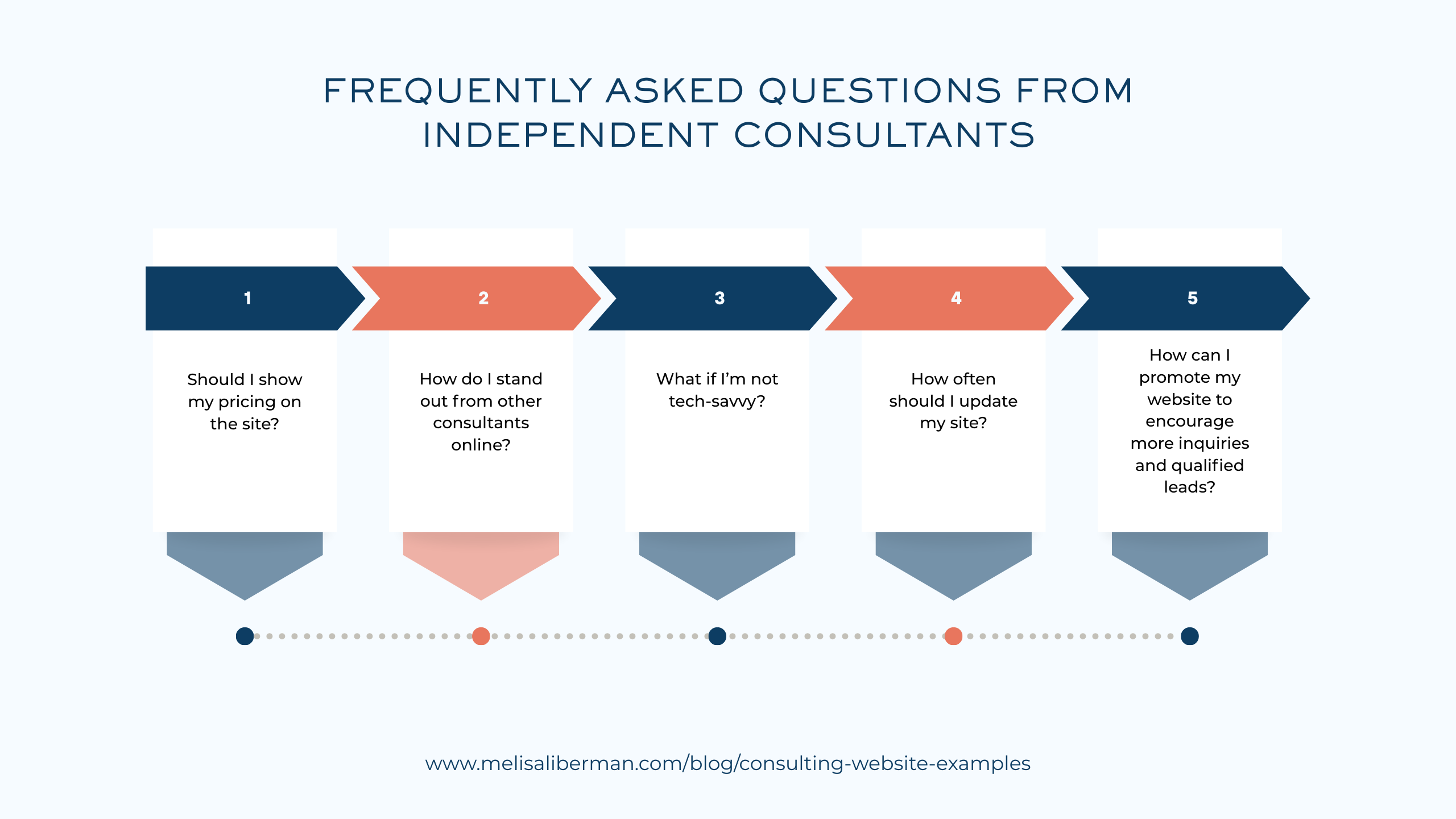
Should I show my pricing on the site?
Unless you’re a consultant with a fixed, packaged offer and you have excess demand, I would not recommend adding your pricing to the website. While you might think it makes it easier to sell, it doesn’t. It commoditizes you.
How do I stand out from other consultants online?
Standing out comes from clarity and point of view, not louder marketing.
Strong thought leadership, consistent visual branding, and personal storytelling differentiate effectively.
What if I’m not tech-savvy?
Template-based platforms and consultant-friendly tools reduce complexity.
Low-maintenance systems and reliable support make upkeep manageable
How often should I update my site?
Quarterly reviews are usually sufficient. Refresh case studies, update messaging, and review SEO performance regularly.
How can I promote my website to encourage more inquiries and qualified leads?
Email marketing, LinkedIn, and networking events drive targeted traffic.
Podcasting, guest appearances, SEO blogging, and referral incentives extend reach over time.
Get the help you need to grow your independent consulting business the right way
Your consulting website should support growth by building trust, clarifying value, and qualifying leads. This article covered how design, messaging, and structure work together to achieve that.
The Scale-IC Program helps independent consultants strengthen positioning, improve client acquisition systems, and build sustainable growth with intention.
If you want help applying these principles to your own business, apply for a Coaching Fit Call or learn more about coaching for consultants.

About