How to Make More Money as a Consultant Without Working More
Dec 24, 2025
Estimated Reading Time: 58 minutes
Download the article as a PDF:

Table of contents
- What you will learn in this article
- Getting your consulting business ready to earn
- How to price your consulting services for maximum profit
- How to make more money by building a consistent pipeline of consulting clients
- Diversifying your consulting services and revenue streams
- Why business owner identity matters if you want to make more money as a consultant
- Get expert support to earn more as an independent consultant
What you will learn in this article
This article is designed to help you get unstuck on a problem that quietly slows down a lot of independent consultants and small firm owners. You will walk away with a clear understanding of what is going wrong, why it keeps happening even when you are experienced, and what to change so you can move forward with more control and consistency.
First, I will break down the core issue most readers are facing and explain why common advice often falls short. You will see exactly what this article will cover and how each section connects to a practical solution you can apply to your own work, not just theory.
Next, we will address the real pain points that show up day to day. Things like unclear processes, inconsistent results, overreliance on referrals, or feeling like you are constantly reinventing the wheel. These challenges are frustrating precisely because you know you are good at what you do, yet the business side does not always reflect that. This section is meant to put language around those frustrations and show you that they are solvable with the right structure.
I will also share perspective drawn from years of hands-on experience working with consultants and small firms who have faced this exact situation. You will see how these patterns show up across different industries, what actually works to fix them, and why certain decisions lead to better outcomes over time. This is not abstract advice, it is based on what I have seen succeed repeatedly.
Finally, I will use insights from serving experienced professionals like you to highlight nuances that are often missed in surface-level content. These are the details that tend to resonate once you have been in business for a while and are ready to refine, not start over. The goal is to help you think like an owner with leverage, not just a practitioner doing great work.
Getting your consulting business ready to earn
Before focusing on marketing or sales tactics, your consulting business needs a solid foundation that can actually support revenue. This is where many experienced consultants underestimate the importance of structure. Skill alone does not translate into consistent income without intentional setup behind it.
Start with your business model. Be clear on how you create value, how that value is delivered, and how you get paid. This includes decisions around project-based work, retainers, advisory engagements, or hybrid models. The right model is the one that aligns with your expertise, your capacity, and your income goals, not whatever is trending in your industry.
Your consulting business structure matters more than it seems. This includes how you package your services, how you scope work, and how responsibility flows through your engagements. A loose structure often leads to scope creep, unpredictable workloads, and revenue that feels accidental rather than intentional. Tightening this up gives you leverage and predictability.
A clearly defined ideal client profile is another non-negotiable. This goes beyond industry or company size. You should understand the specific problems your best clients are trying to solve, how they make buying decisions, and why they value outside expertise. When this is clear, everything else, from messaging to proposals, becomes easier and more effective.
You also need to ensure your business registration and legal setup are handled correctly. This includes choosing the right entity type, having contracts that protect you, and setting up basic financial systems. These steps may feel administrative, but they directly impact your ability to scale and protect your income.
Finally, your consulting business plan should be practical, not aspirational. It should outline your revenue targets, service mix, pricing strategy, and capacity constraints. Think of it as an operating plan rather than a pitch deck. This plan gives you a reference point for decisions and helps you stay focused on activities that actually move the business forward.
When these elements are in place, your consulting business is positioned to earn in a way that is repeatable and sustainable, not reactive.
Understanding what it really takes to make money as a consultant
Making money as a consultant is less about working harder and more about thinking differently about how your business operates. This is where an entrepreneurial mindset becomes essential. You are not just delivering expertise, you are designing a business that converts that expertise into reliable revenue. Without this shift, even highly skilled consultants stay stuck in feast or famine cycles.
A clear client acquisition strategy is a major differentiator between consultants who earn sporadically and those who earn consistently. Relying on referrals alone puts you in a reactive position. Sustainable income requires intentional decisions about where your clients come from, how they find you, and why they choose you over alternatives.
Your consulting revenue models also play a critical role. Many consultants default to hourly or day rates because they feel familiar, but this often traps you in a pure time versus value exchange. When your income is directly tied to hours worked, you cap your earning potential and limit scalability. Shifting toward value-based pricing, retainers, or outcome-driven engagements allows your revenue to reflect impact, not just effort.
Strong positioning and differentiation are what make those revenue models work. You need to be clear about who you serve, the specific problems you solve, and why your approach is different. A defined target market and thoughtful niche specialization help you stand out in a crowded landscape. Generalists often struggle to command premium fees because their value is harder to articulate.
This is where your unique selling proposition (USP) comes into play. Your USP should connect directly to market demand and real ideal client pain points. It is not about being everything to everyone, it is about being the obvious choice for a specific type of client with a specific problem they are motivated to solve.
When you align mindset, acquisition, pricing, and positioning, earning money as a consultant becomes far more predictable. The goal is not just to get paid for your work, but to build a business where revenue is a byproduct of clear strategy and intentional choices.
Click here to take the Consultant’s Personal Branding Assessment.
How to price your consulting services for maximum profit
Pricing is one of the fastest ways to change your consulting income, and one of the easiest places to sabotage it. Most consultants underprice not because they lack skill, but because they price based on comfort instead of strategy. If your goal is maximum profit, your pricing needs to reflect value, protect your capacity, and create room for healthy profit margins, not just cover your time.
Start with the real goal: profitable revenue, not “fair” rates
A “fair” hourly number is rarely the right benchmark. Hourly thinking reinforces a time versus value exchange and makes it hard to capture the upside of your expertise. A more useful starting point is: what does this engagement enable for the client, and what does it cost you to deliver at a high standard? That shift is the foundation of value-based pricing.
Value-based pricing does not mean you name an outrageous number and hope for the best. It means you anchor your fee to outcomes, risk reduction, speed, or avoided costs. For example, if your work helps a client shorten a sales cycle, reduce churn, improve conversion, or avoid a costly misstep, your fee should align with that impact, not the number of calls you take.
Use pricing psychology to increase both trust and conversion
A lot of consultants treat pricing like a math problem. It is also a perception problem. Pricing psychology matters because clients are not buying hours, they are buying confidence and clarity.
A few practical principles that hold up in consulting:
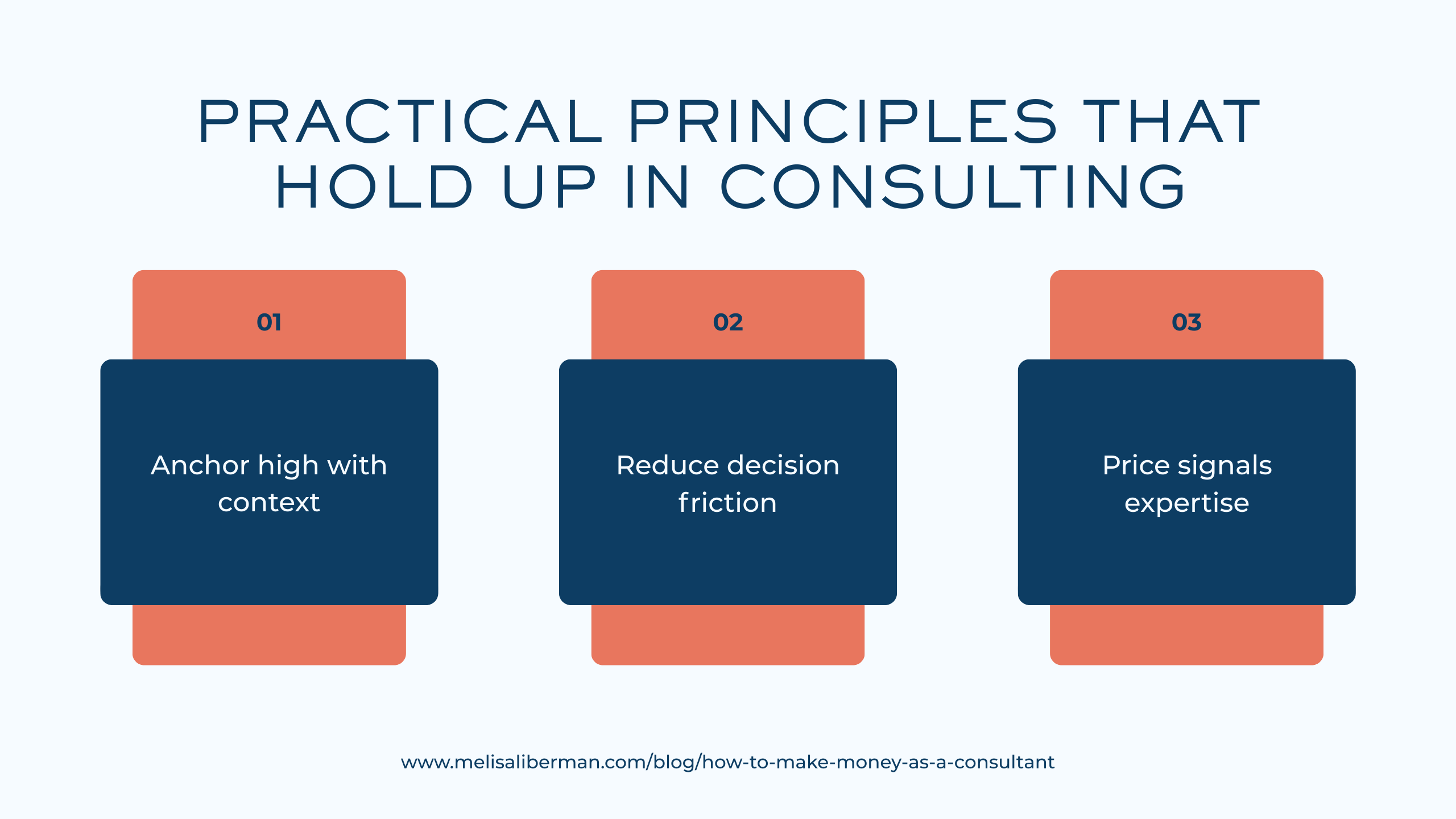
- Anchor high with context: If you want to charge premium fees, you need to explain what premium delivery includes, like rigor, speed, access, and decision support.
- Reduce decision friction: Clear packages and boundaries help clients say yes faster than a custom scope with endless variables.
- Price signals expertise: In many B2B contexts, being the cheapest option can be a red flag. The goal is “credible premium,” not “mysterious expensive.”
Build service tiers that match different buyer readiness
Service design is a profit lever. Well-structured service tiers let you serve different client needs without discounting. They also help you protect your time and create an intentional upgrade path.
Common tier structures that work for independent consultants:
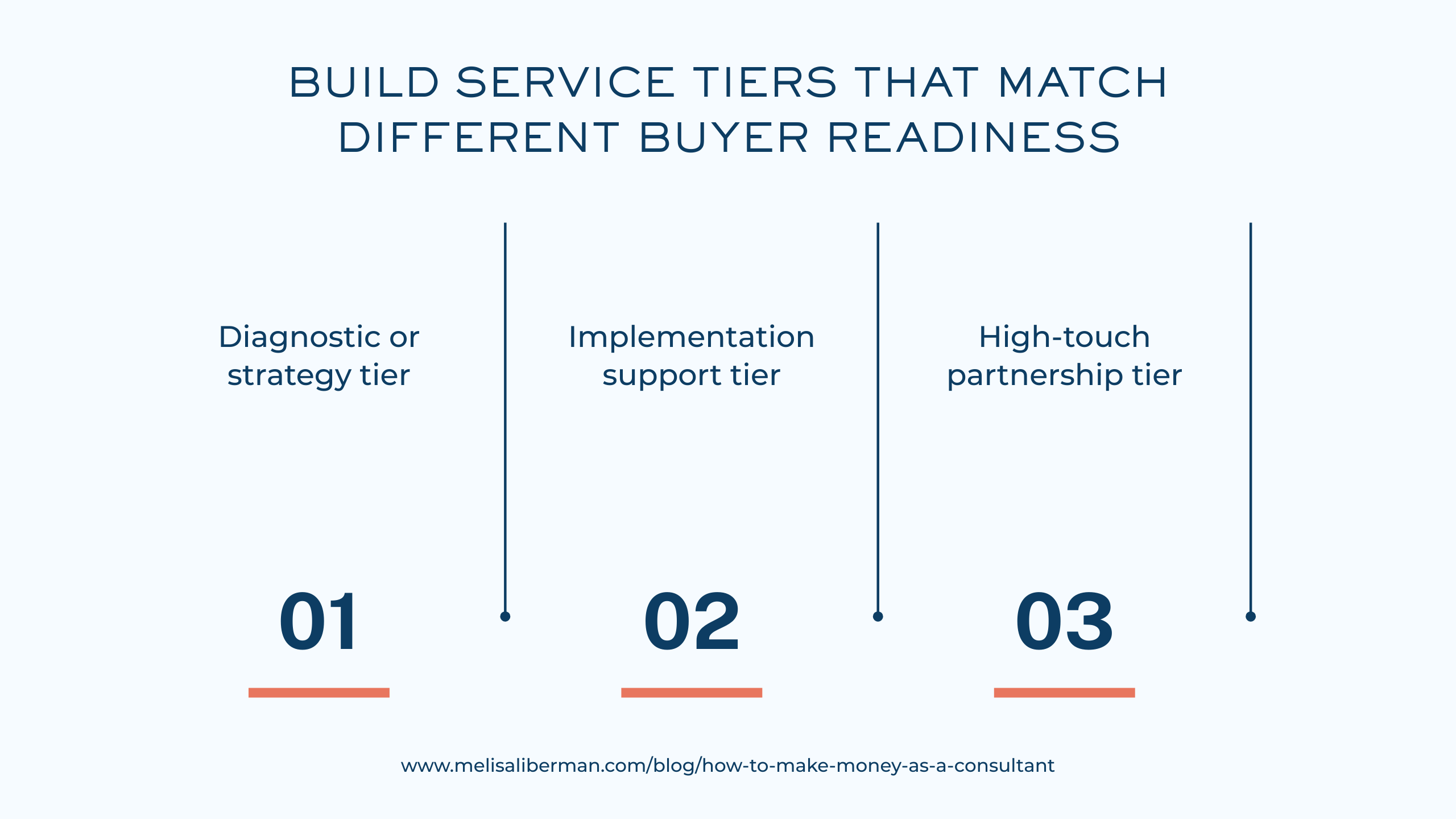
- Diagnostic or strategy tier: A short engagement that clarifies the problem and recommends next steps. High margin, low delivery drag.
- Implementation support tier: You advise and guide the team through execution with defined touchpoints.
- High-touch partnership tier: Closer collaboration, faster feedback loops, deeper access, typically priced highest.
This approach improves profitability because you can reserve your most intensive involvement for clients who pay for it, while still capturing revenue from clients who need less.
Define a consulting rate strategy that protects your capacity
Your consulting rate strategy should account for three realities:
- You are not billable 40 hours a week, even if you are busy.
- Your best work requires margin, not constant overload.
- Your price must include the cost of running a business, not just delivering a service.
If your rates are based on a fantasy utilization rate, your profit will always be fragile. Build pricing that assumes time for business development, admin, learning, and recovery. Consultants who ignore this end up “fully booked” and still under-earning.
Audit your profit margins at the offer level
Most consultants do not know their margins by offer, and that is a problem. You can have strong revenue and weak profitability if delivery is too time-intensive or scope is not controlled.
A simple way to pressure-test margins:
- Estimate delivery time realistically, including prep and follow-up.
- Multiply by your internal target hourly value (even if you do not sell hourly).
- Add any hard costs, like tools, subcontractors, or travel.
- Compare that to the fee and ask: is this worth the opportunity cost?
If the answer is no, adjust scope, increase price, or redesign the offer. “Maximum profit” usually comes from better boundaries and packaging, not just raising rates across the board.
Let value-based pricing guide, and tiers execute
If you want higher profit without burning out, pair value-based pricing with clean tiered offers. Value-based pricing sets the ceiling based on impact. Service tiers make the decision easy for the buyer and manageable for you to deliver.
The end goal is simple: pricing that matches your expertise, signals the right positioning, and leaves you with enough margin to run your business like an owner.
Click here to take the Compelling Independent Consulting Offers Scorecard.
How to set your consulting rates (and actually get them)
Setting your rates is only half the job. The real skill is setting rates you can defend, communicate clearly, and collect without dragging every deal into negotiation. If you want to actually get your rates consistently, your pricing has to be anchored in logic, positioned correctly, and supported by a process that makes your fee feel inevitable, not arbitrary.
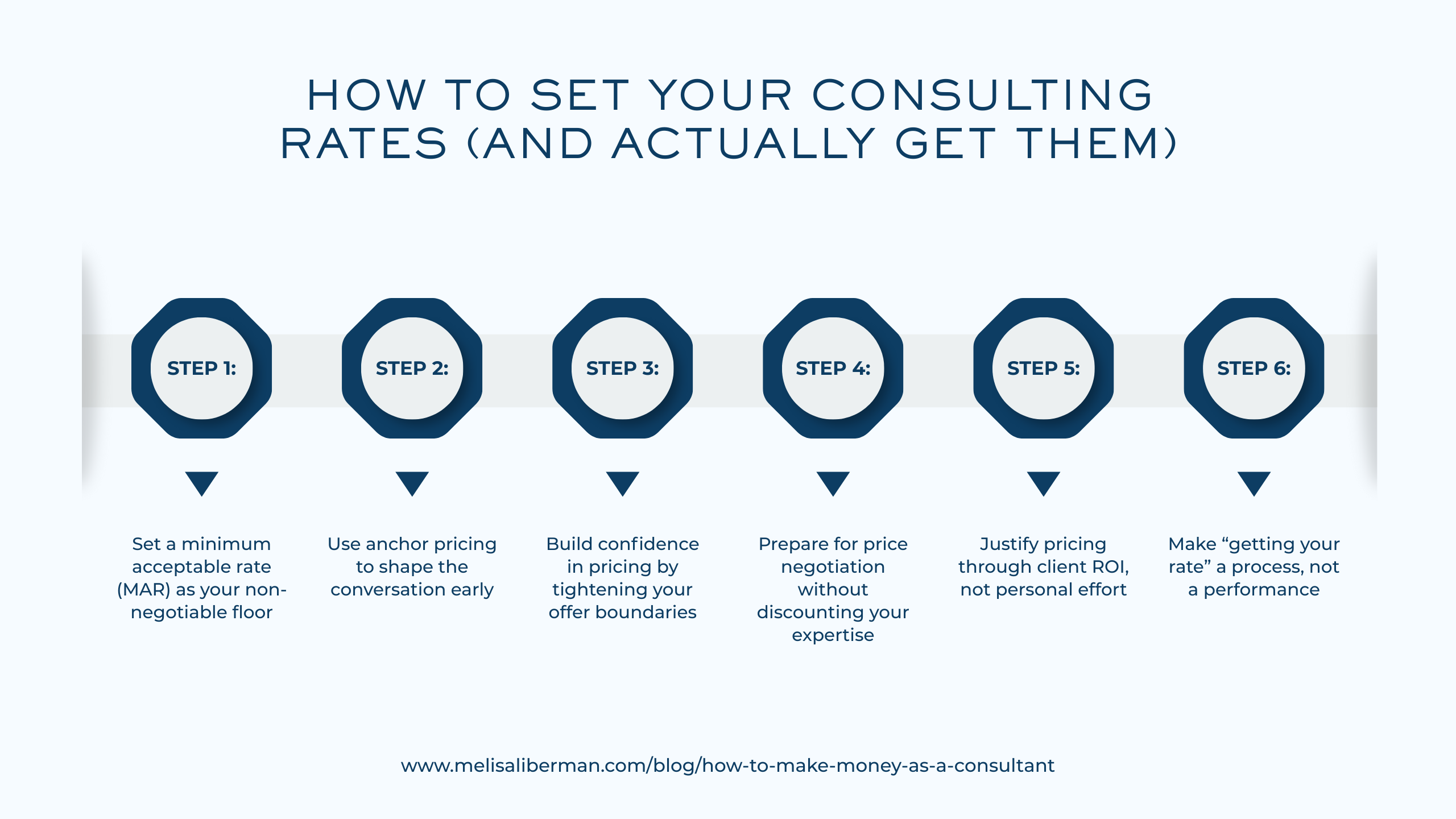
Step 1: Set a minimum acceptable rate (MAR) as your non-negotiable floor
Before you decide what to charge, define your minimum acceptable rate (MAR). This is the lowest price you are willing to accept for a specific type of work, given the effort required, the opportunity cost, and the margin you need to run your business responsibly.
Your MAR is not “what I can get away with.” It is what makes the engagement worth doing. If a project comes in below MAR, you either change the scope, change the delivery model, or walk away. This is a key ownership mindset shift: saying no is a pricing strategy.
Practical way to calculate MAR:
- Start with the annual income you want to take home.
- Add overhead, taxes, benefits, and business investments.
- Divide by realistic billable capacity, not your calendar hours.
- Add a buffer for risk and delivery complexity.
Even if you do not sell hourly, this gives you a grounded floor you can use to pressure-test any fixed-fee proposal.
Step 2: Use anchor pricing to shape the conversation early
Anchor pricing is one of the most effective tools you have, especially in B2B consulting where buyers often do not have a precise benchmark. The first credible number introduced in the conversation tends to shape expectations.
Anchoring does not mean blurting out a price on a discovery call. It means introducing a range tied to outcomes and scope levels so the client understands what “small,” “standard,” and “strategic” look like in your world.
For example:
- “Engagements like this typically fall between X and Y depending on depth and speed.”
- “If you need a quick diagnostic, it is usually around X. If you want implementation support, it is closer to Y.”
This protects you from getting trapped by a client’s budget framing and it also positions you as someone who has done this before.
Step 3: Build confidence in pricing by tightening your offer boundaries
Confidence in pricing is rarely a mindset problem. It is usually a structure problem. When your scope is fuzzy, your confidence drops because you know you are exposing yourself to unlimited work for a fixed fee.
The fastest way to feel confident is to make your service boundaries explicit:
- What is included and what is not
- How many meetings, reviews, or deliverables
- The client responsibilities required for success
- The timeline and decision points
When your offer has clear edges, your pricing feels more defensible because it is tied to a defined delivery system.
Step 4: Prepare for price negotiation without discounting your expertise
Price negotiation is not inherently bad. It becomes a problem when the only lever you use is lowering the fee. A better approach is to treat negotiation as a scope and value conversation.
If a client pushes back, you have options that preserve your positioning:
- Adjust scope: Remove deliverables, reduce access, shorten the timeline.
- Adjust payment structure: Split into milestones, or offer a retainer to spread cost.
- Adjust delivery model: Move from done-for-you to advisory, or introduce a lighter tier.
Notice the pattern: you protect the fee by changing what they get, not by undermining your value.
Step 5: Justify pricing through client ROI, not personal effort
Clients do not care how long something takes you. They care what it changes for them. If you want your rates accepted, you need a simple, credible way to explain client ROI justification.
This does not require a complicated calculator. It requires clarity:
- What problem are they solving?
- What does that problem currently cost them (time, revenue, risk, stalled decisions)?
- What happens if it is not solved?
- What is the upside if it is solved quickly and correctly?
When you can connect your fee to avoided costs, accelerated outcomes, or reduced risk, the price feels rational. This is where you move from “selling consulting” to selling impact.
Step 6: Make “getting your rate” a process, not a performance
Most consultants think they fail to get their rates because they are not persuasive enough. In reality, they fail because the buying process is unclear.
A simple process increases close rates at premium fees:
- Discovery focused on diagnosing and quantifying the problem
- A proposal that frames scope in tiers or clear options
- A walk-through call that reinforces value and decision criteria
- A clean close with contract and payment terms ready
When the process is structured, your pricing holds. When it is improvised, negotiation creeps in.
Click here to take the Consultant’s Pricing Assessment.
Understanding different revenue models for consultants
Your revenue model is not just a pricing choice, it is a delivery and lifestyle choice. It determines how predictable your income is, how you allocate your time, and how much leverage you can build into the business. Many consultants stay stuck because they are trying to scale a model that was only designed to pay them for effort.
Below are the most common consulting revenue models, what they are best suited for, and the tradeoffs to consider.
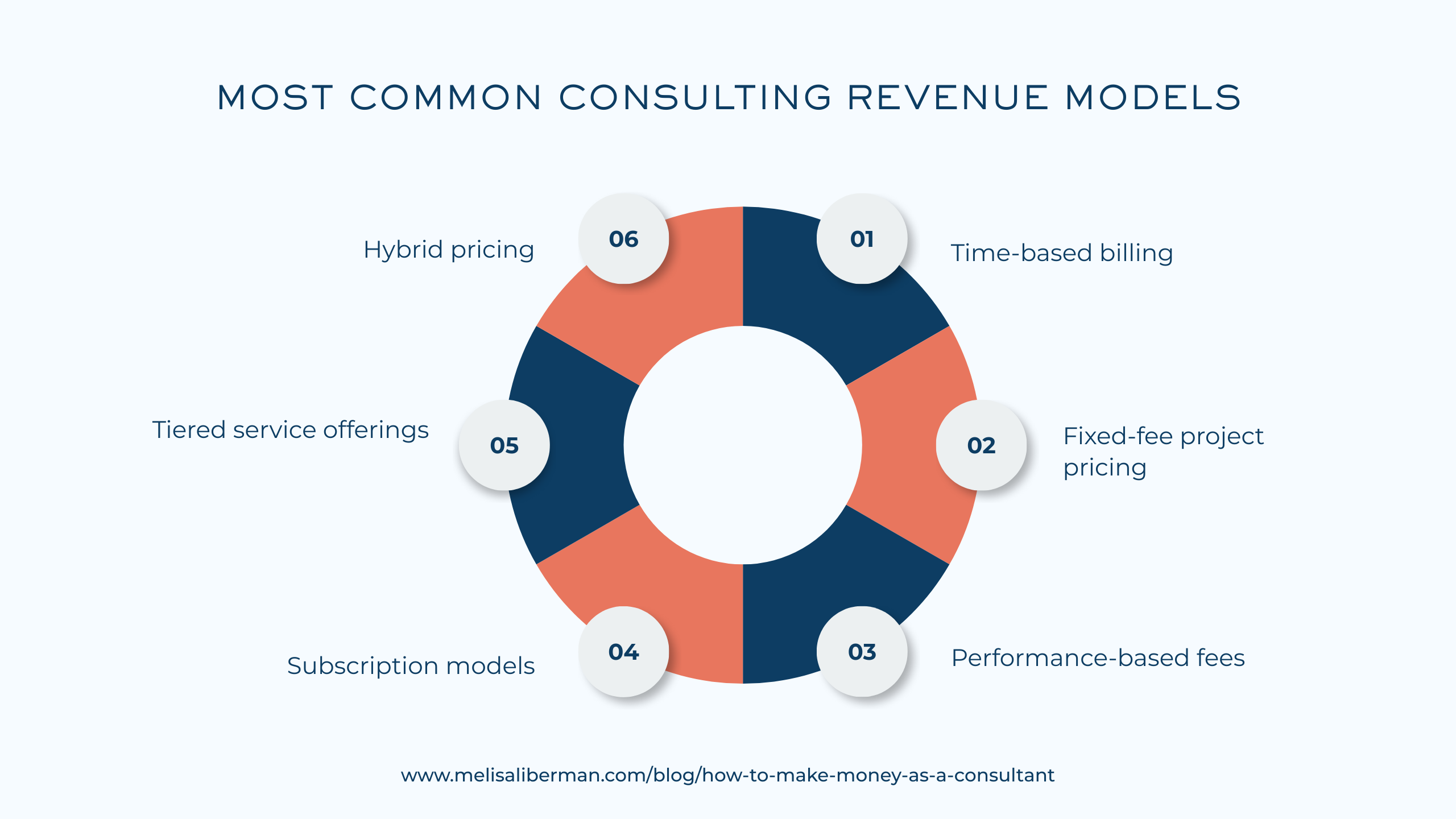
Time-based billing
Time-based billing includes hourly, daily, or weekly rates. It is straightforward, easy for clients to understand, and can work well when scope is truly unknown or when you are brought in for on-demand expertise.
The downside is that time-based billing often caps your income and quietly trains clients to evaluate you on cost per hour instead of impact. It also creates pressure to prove you are “working,” which can lead to over-delivery and blurred boundaries.
Use this model intentionally when:
- The work is exploratory or unpredictable
- You need a short-term bridge for cash flow
- The client’s procurement process demands it
If you use time-based billing long-term, set firm guardrails around utilization and don’t pretend your calendar hours equal billable hours.
Fixed-fee project pricing
Fixed fees are often a stepping stone out of hourly work. You define a scope, timeframe, and set price. This can increase profitability if you deliver efficiently and manage scope tightly.
The risk is that sloppy scoping turns fixed-fee work into underpaid hourly work. Fixed fees only work when your delivery process is repeatable enough to estimate effort accurately and protect your margin.
Performance-based fees
Performance-based fees tie some or all of your compensation to measurable outcomes, like revenue growth, cost savings, or performance improvements. In theory, this aligns incentives and can unlock high upside.
In practice, it adds complexity:
- Outcomes may depend on factors outside your control
- Measurement can be disputed
- Timelines may not match when results show up
If you use performance-based fees, consider structuring them as a base fee plus a performance component, rather than pure contingency. That protects your downside while keeping the upside.
Subscription models
Subscription models are recurring monthly fees for ongoing access, advisory support, or a defined set of deliverables. This is one of the most effective ways to build revenue predictability as a consultant, especially if you have clients who need steady guidance over time.
Subscription models work best when:
- You provide ongoing decision support
- The client needs consistent momentum, not one-time deliverables
- You can define clear boundaries around access and response time
The common failure mode is selling “unlimited” support. Subscription models require strong scope boundaries and a delivery rhythm so your profitability stays intact.
Tiered service offerings
Tiered service offerings let clients choose between levels of support, like a diagnostic tier, an implementation tier, and a high-touch partnership tier. This model improves conversion by meeting different budgets and levels of readiness without discounting.
Tiers also help you protect capacity. Your highest tier can include deeper access, faster turnaround, or more involvement, while the lower tiers remain profitable because they are lighter to deliver.
This is often a clean way to introduce premium pricing, because the value is clearly differentiated instead of being framed as “the same thing, just more expensive.”
Hybrid pricing
Hybrid pricing combines two or more models, such as:
- A fixed project fee plus a performance bonus
- A subscription retainer plus a one-time strategy sprint
- Time-based billing for exploratory work, then fixed-fee for implementation
Hybrid models are common in mature consulting businesses because they allow you to match pricing to the nature of the work. The key is making the logic simple for the client. If the structure feels complicated, it creates friction and invites negotiation.
How to choose the right model
The right revenue model depends on three things:
- Market demand: What your buyers expect and what they will pay for
- Delivery reality: Whether you can scope and deliver consistently
- Business goals: Predictability, scalability, lifestyle, and margin
If you want maximum leverage, move away from pure time-based billing over time. Build models that reward repeatable value, not just effort, and that make your revenue more predictable than your energy level.
Click here to read the article on How to Package Your Consulting Services: Step-By-Step.
Structuring productized and packaged offerings
If you want more predictable revenue and smoother delivery, you need to stop selling “custom consulting” as your default. Custom work has its place, but it is hard to market, hard to scope, and hard to scale. Packaged and productized offerings solve this by turning what you already do well into a repeatable service with clear boundaries, outcomes, and deliverables.
This is what I mean by offerization: taking your expertise and designing it into an offer that clients can understand, buy, and say yes to without a long education process.
Start by defining a signature offer
A signature offer is your primary way of helping a specific type of client solve a specific high-value problem. It is not your only service, but it becomes your anchor. When your signature offer is clear, your marketing gets sharper, discovery calls get easier, and pricing becomes more defensible.
Strong signature offers usually share a few traits:
- They solve a painful, high-priority problem
- The outcome is easy to explain in plain language
- The process is repeatable, even if the details vary
- The scope has clear edges
If your offer feels like “I can help with anything,” you do not have a signature offer yet. You have a set of skills. The goal is to convert those skills into a defined path a buyer can recognize.
Package around outcomes, not activities
The biggest mistake in consulting packages is building them around what you do instead of what the client gets. Clients do not want “six calls and a deck.” They want clarity, direction, alignment, and results.
Your package should communicate:
- The outcome or transformation
- The milestones that get them there
- The decisions they will be able to make afterward
- The deliverables that support those milestones
This creates a value-forward framing and it also makes the package easier to price, because it is tied to impact and completion, not hours.
Design standardized deliverables that still feel premium
Standardized deliverables are what make a service scalable. They reduce the cognitive load of reinventing your work every time and they improve quality because you can refine the same assets across clients.
Standardized does not mean generic. It means consistent structure with tailored inputs.
Examples that work well in consulting:
- A diagnostic scorecard with a repeatable rubric
- A strategy brief template that captures decisions, not just notes
- A roadmap format that clarifies priorities, sequencing, and owners
- A meeting cadence and agenda structure that keeps engagements moving
When your deliverables have a consistent framework, you deliver faster, clients feel guided, and your margins improve.
Build scalable services by controlling scope and delivery
Scalable services require boundaries. The more open-ended the engagement, the harder it is to protect capacity and profitability.
To make a package scalable, define:
- Timeline: start and end dates, plus what happens if the client delays
- Access: how often they can meet with you, response times, async support limits
- Inputs: what the client must provide and by when
- Change control: how scope changes are handled and priced
This is not about being rigid. It is about making the service reliable for both sides. Clear scope is what allows you to confidently sell and deliver at higher price points.
Use packages to create a value ladder
One of the biggest advantages of packaged services is that you can create a logical path for clients to keep working with you without starting from scratch. This might look like:
- A diagnostic or audit
- A strategy and prioritization sprint
- Implementation advisory support
- Ongoing retainer or subscription
This structure increases lifetime value while keeping delivery manageable. It also helps clients feel like there is a plan, which builds trust.
Productized does not mean “cheap,” it means “clear”
Many consultants resist packaging because they think productized means lower-end. In reality, productization is often what enables premium pricing. When your offer is clear, your outcomes are defined, and your process is proven, the buyer is not paying for your time. They are paying for certainty.
That is what packaged consulting should create: a clear, repeatable path to a meaningful result.
How to make more money by building a consistent pipeline of consulting clients
You can have the best pricing and offers in the world and still under-earn if your client flow is inconsistent. A consistent pipeline is the difference between a consulting business that feels stable and one that feels like constant pressure. This is not about doing more marketing, it is about building a client acquisition system you can run every week, even when delivery is busy.
Start with a lead generation strategy you can sustain
A good lead generation strategy is boring in the best way. It is repeatable, trackable, and aligned with where your ideal clients already spend time.
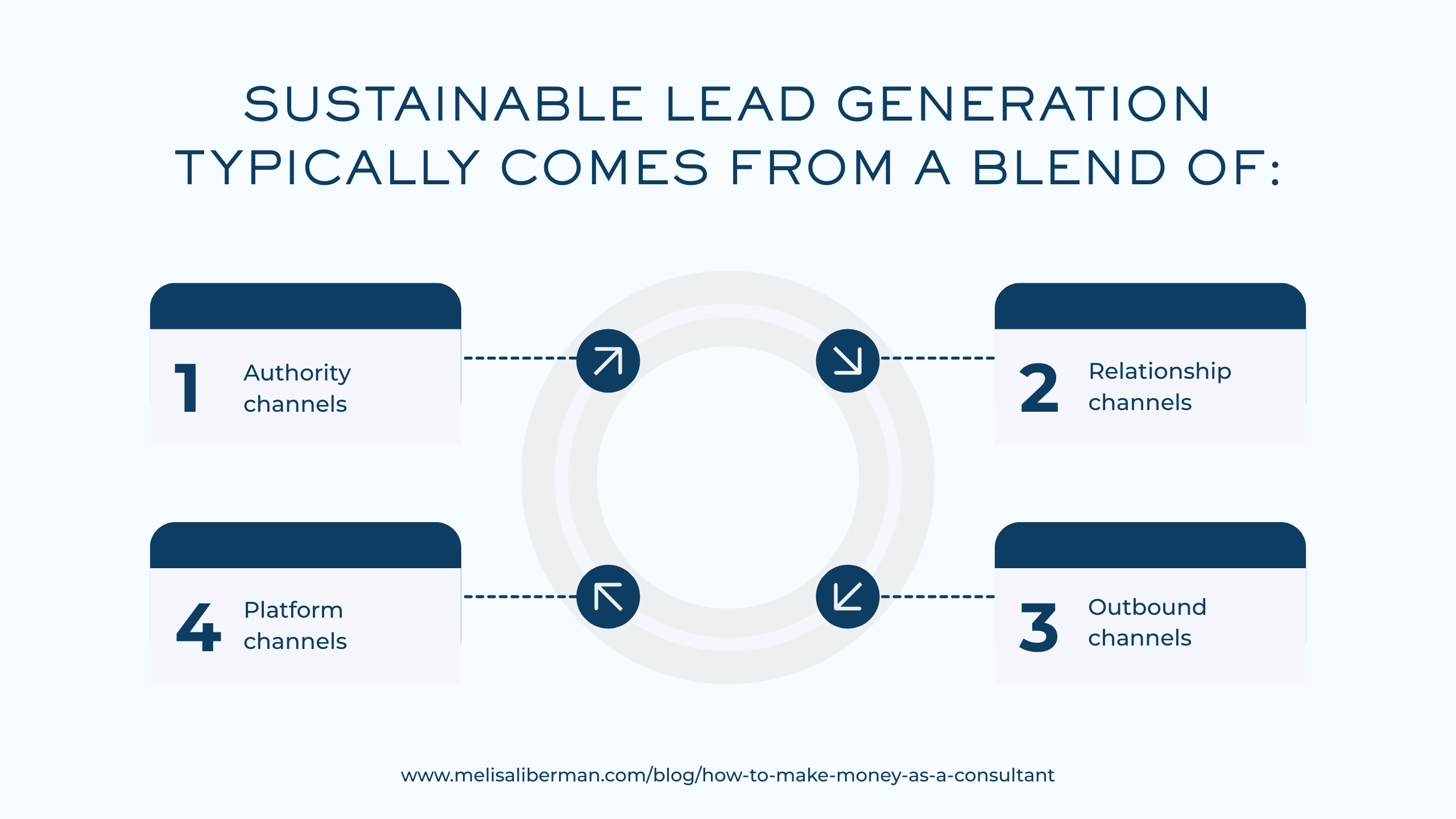
For most independent consultants, sustainable lead generation typically comes from a blend of:
- Authority channels (content, speaking, podcast guesting, newsletters)
- Relationship channels (referrals, partners, former colleagues, alumni networks)
- Outbound channels (targeted outreach, warm introductions, selective cold outreach)
- Platform channels (LinkedIn, industry communities, niche events)
The key is picking one or two primary channels and running them consistently. Spreading yourself across five channels usually creates activity without momentum.
Treat pipeline management like an operating system
Most consultants do not have a pipeline problem. They have a pipeline management problem. Leads show up, conversations happen, and then everything sits in someone’s inbox until the next revenue panic.
A simple pipeline system requires:
- Clear stages (for example: new lead, discovery scheduled, proposal sent, decision pending, closed won, closed lost)
- A weekly review cadence
- Defined next actions for every active opportunity
This is the mindset shift: your pipeline is an asset you manage, not a mood you react to.
Build a client acquisition system around conversion, not visibility
Visibility is not the goal. Conversions are the goal. A strong client acquisition system focuses on moving the right people through a clear buying journey.
At a basic level, most consulting conversion funnels look like this:
- Awareness: The right client learns you exist and understands what you do.
- Trust: They see proof, clarity, and relevance to their problem.
- Engagement: They take a low-friction step, like booking a call or replying to a message.
- Decision: They evaluate scope, fit, and confidence, then buy.
If your funnel is weak, diagnose where it breaks:
- Plenty of views, but no calls booked usually means messaging or CTA problems.
- Calls booked, but no proposals usually means discovery is not focused on a solvable, funded problem.
- Proposals sent, but low close rate usually means weak positioning, unclear scope, or poor ROI framing.
Create a consultant marketing plan that supports weekly action
A consultant marketing plan should not be a quarterly document you write and ignore. It should translate into weekly actions that fill and move the pipeline.
A practical weekly plan might include:
- One authority asset (post, article, email, or short case story)
- Five to ten targeted reach-outs to warm or well-matched contacts
- One partner touchpoint (a referral partner, agency, or complementary provider)
- One pipeline review session to move deals forward
This is how you avoid the feast or famine cycle. You do not wait until you need clients to start marketing. You run the system regardless of how busy you are.
Use simple metrics to increase revenue predictability
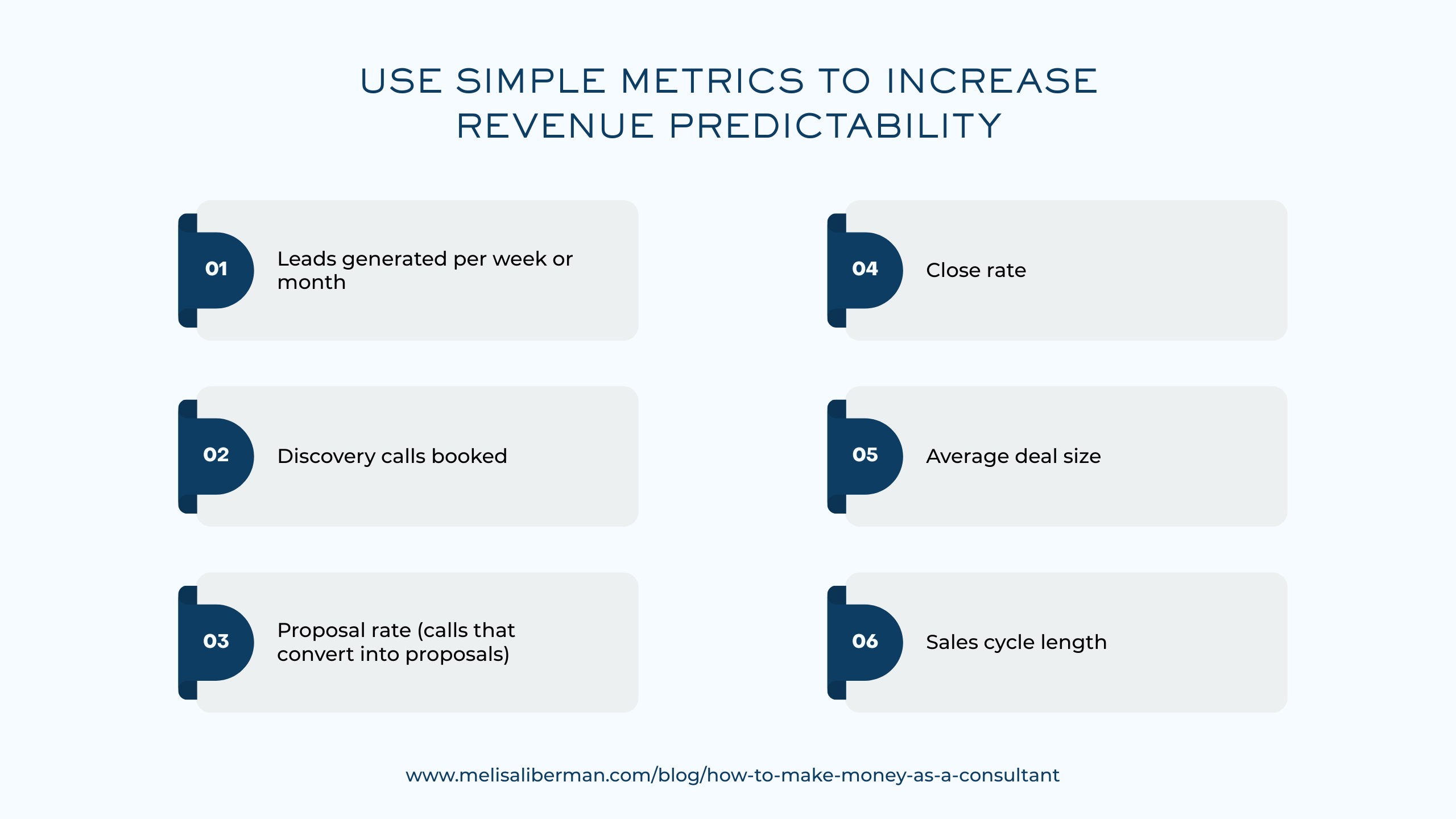
You do not need a complex CRM to improve results, but you do need a few basic numbers:
- Leads generated per week or month
- Discovery calls booked
- Proposal rate (calls that convert into proposals)
- Close rate
- Average deal size
- Sales cycle length
With those metrics, you can forecast revenue and make smarter decisions. For example, if your close rate is strong but lead volume is low, you focus on lead gen. If lead volume is strong but close rate is low, you focus on positioning, proposal quality, or qualification.
Consistency is the compounding advantage
Consulting pipelines rarely fail because the consultant is not smart. They fail because the consultant is inconsistent. When you build a pipeline system you can run in small increments, you stop relying on urgency and start relying on process.
That is how you make more money as a consultant: not by chasing clients harder, but by creating a steady, repeatable flow of right-fit opportunities.
To set up your pipeline, download the OnePageCRM Consultant’s Configuration Guide.
Moving beyond referrals: Creating a repeatable lead generation system
Referrals are great, until they are not. The problem is not that referrals are bad, it is that they are uncontrollable. If you want consistent revenue, you need a lead generation system you can run on purpose, not one that depends on other people remembering you at the right moment.
Moving beyond referrals does not require becoming a high-volume outbound machine. It requires a repeatable business development rhythm that creates qualified conversations every month.
The shift: from “networking” to a business development formula
A repeatable system is basically a business development formula. You decide:
- Who you are targeting
- How you will reach them
- What you will say
- How you will track and follow up
- How often you will run the cycle
Most consultants do the first three pieces occasionally and skip the last two. The tracking and follow-up are what make it compound.
A simple Lead Gen Sprint Method you can run every month
One approach I like is a short, focused Lead Gen Sprint Method. Think of it as a two-week burst of intentional outreach and follow-up that you repeat monthly or quarterly, depending on your pipeline needs.
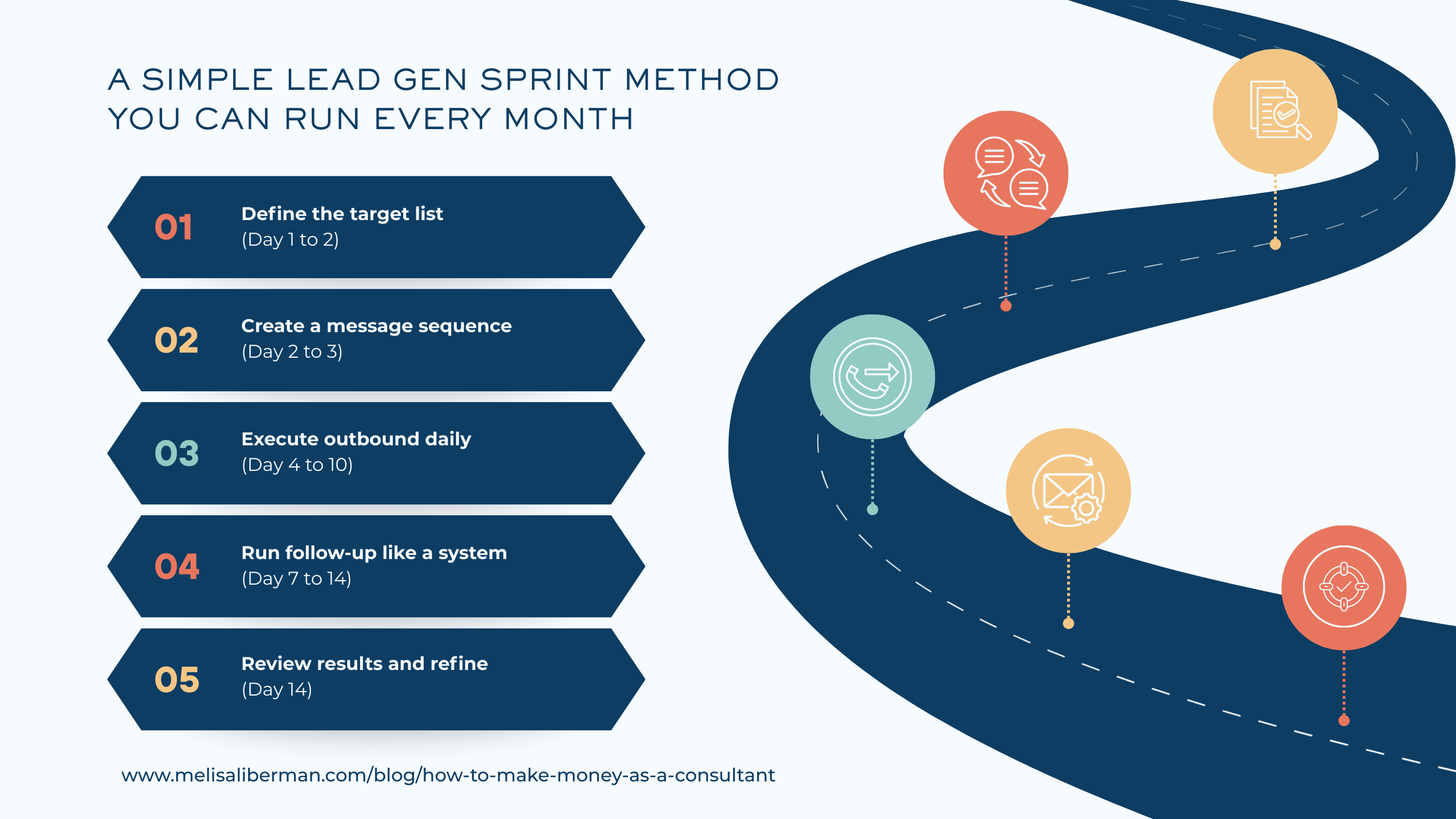
A practical sprint structure:
- Define the target list (Day 1 to 2)
Build a list of 25 to 50 accounts or individuals who match your ideal client profile. Make the list specific, not “anyone in SaaS.” Include titles, company context, and a hypothesis about what they might need. - Create a message sequence (Day 2 to 3)
Write one strong initial outreach message and two follow-ups. Your goal is not to pitch your full service, it is to open a relevant conversation. The best messages are specific and low friction, for example: a short observation, a credible insight, and a simple question. - Execute outbound daily (Day 4 to 10)
Do small daily outreach blocks, even 20 to 30 minutes. Consistency matters more than volume. This is your outbound lead generation engine. - Run follow-up like a system (Day 7 to 14)
Most deals are won in follow-up, not first contact. Follow-up should be expected and professional, not awkward. Your follow-up job is to resurface relevance, not beg for a reply. - Review results and refine (Day 14)
Track reply rates, booked calls, and what messaging themes performed best. Then adjust the next sprint.
This sprint model keeps lead generation contained and repeatable, so it does not eat your entire schedule.
Build a cold outreach system that does not feel spammy
A cold outreach system works when it is targeted and grounded in the client’s reality. Generic outreach fails because it forces the prospect to do the work of connecting the dots.
A better outreach pattern:
- Start with a specific observation about their context
- Name the likely consequence of not solving it
- Offer a small, credible next step
For example, instead of “I help companies grow,” you might reference a common operational bottleneck you see in their stage of growth and ask a question that invites a response.
Also, keep your ask small. The first goal is a conversation, not a sale.
Use CRM tracking to make follow-up inevitable
If you are serious about moving beyond referrals, you need CRM tracking, even if it is lightweight. The point is not software sophistication, it is visibility.
At minimum, track:
- Who you contacted
- When you contacted them
- What you said
- Their response status
- The next follow-up date
This prevents opportunities from disappearing just because you got busy delivering. When your follow-up is tracked, your pipeline becomes more predictable.
If you already use a CRM, set up a simple pipeline with stages that match your process. If you do not, a spreadsheet can work as long as you review it weekly.
The real advantage: you stop waiting for permission to grow
Referrals will always be a valuable channel, but they should be a bonus, not the backbone. A repeatable lead gen system gives you control. It lets you create pipeline when you want it, smooth out revenue dips, and build a business that is not dependent on chance.
Run a sprint, track it, follow up, and repeat. That consistency is what turns lead generation from a stressful scramble into a reliable operating habit.
Diversifying your consulting services and revenue streams
Relying on one core offer can work for a while, especially if you have strong referrals and a consistent niche. The risk is that a single offer creates a single point of failure. One delayed decision, one budget freeze, one client churn event, and your revenue swings hard.
Revenue diversification is not about adding random products. It is about building a deliberate service ecosystem that creates multiple ways for clients to engage with you at different levels, timelines, and budgets. Done well, diversification improves stability, increases lifetime value, and supports business scalability without turning your business into a chaotic menu of options.
Start with an offer stack, not a pile of ideas
Think in terms of an offer stack: a set of related services that solve adjacent problems for the same target market. Your offers should ladder logically, so each one can lead to the next when the client is ready.
A simple offer stack often includes:
- A focused diagnostic or audit
- A strategy engagement or roadmap
- Implementation support or advisory
- Ongoing retainer, subscription, or governance support
This structure creates momentum. Instead of constantly hunting for brand-new clients, you build a path that converts initial wins into longer-term relationships.
Choose diversification that strengthens your core positioning
The easiest way to damage revenue is to diversify into services that dilute your positioning. If every offer targets a different buyer or solves a totally different problem, you will spend all your time re-explaining what you do, and your marketing will lose sharpness.
Better diversification builds outward from what you are already known for:
- If you lead strategy, add implementation advisory or decision support retainers.
- If you specialize in operational fixes, add audits, training, or governance systems.
- If your work drives measurable outcomes, add performance components or optimization cycles.
Your best next offer is usually a “neighbor” to your core offer, not a leap into a new category.
Build multiple income streams by varying delivery, not audience
A clean way to create multiple income streams is to keep the same audience and vary the delivery model. This keeps your messaging consistent while expanding how clients can buy.
Common expansions that stay aligned:
- Productized diagnostics: repeatable audits or assessments with standardized deliverables
- Tiered advisory packages: different levels of access and support
- Workshops and team training: paid facilitation tied to your core methodology
- Retainers or subscriptions: ongoing support with clear boundaries
- Implementation partnerships: collaborating with agencies or operators to deliver outcomes without you doing all the execution
Notice that these are not “new businesses.” They are different ways of packaging the same expertise.
Use diversification to increase scalability and margin
Diversification should make the business easier to run, not harder. The best mixes usually include a balance of:
- Higher ticket, high-touch work (premium margin, lower volume)
- Mid-tier recurring work (predictable revenue, manageable delivery)
- Lower-touch offers (scalable, supports lead generation and trust)
This is where business scalability shows up. When your revenue is spread across different types of engagements, you reduce dependence on any single project and you can plan capacity more intelligently.
Avoid the common trap: offering more because you feel uncertain
Many consultants diversify too early because they are uncomfortable with focus. They add services as a way to avoid saying no, or to compensate for inconsistent lead flow. That tends to create a messy business that is harder to sell and harder to deliver.
A better rule: diversify after you have one offer that sells consistently and delivers cleanly. Then build around it with intention.
Diversification is a strategic choice, not a creativity exercise
The goal of a diversified consulting business is stability and leverage. A strong service ecosystem gives you options: you can smooth income, increase retention, and build longer-term client relationships without relying on luck.
Design your offer stack so it feels cohesive, strengthens your positioning, and gives clients a clear path to keep working with you as their needs evolve.
Expanding your service offerings to unlock additional revenue
Once you have a core offer that sells reliably, the next growth lever is not “more leads.” It is increasing revenue per client by expanding what you offer in a way that feels natural, valuable, and easy to buy. The goal is client lifecycle expansion: serving the same client through more stages of their journey, instead of constantly starting over with new clients.
This is where many consultants leave money on the table. They solve the initial problem, deliver great work, then walk away even though the client still has adjacent needs and is now primed to trust you.
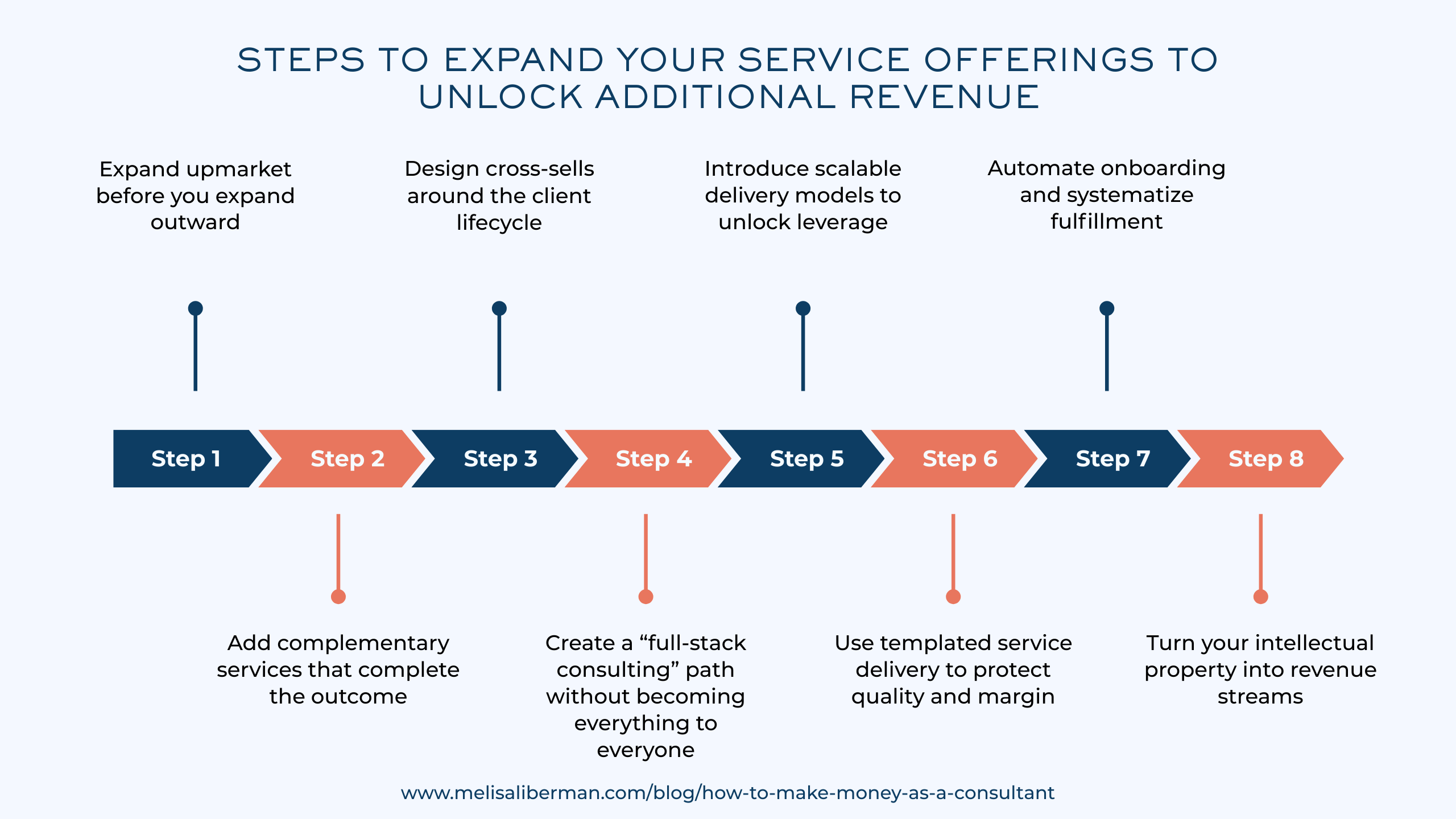
Step 1: Expand upmarket before you expand outward
Adding upmarket services is often the cleanest path to additional revenue because you are deepening value, not changing your audience. Upmarket does not have to mean enterprise only. It means higher stakes, higher leverage work, such as:
- Executive decision support and advisory
- Strategy to execution governance
- Operating model design
- Team alignment and change enablement
Upmarket work is typically more profitable because it is closer to revenue, risk, and high-impact decisions. The key is to package it as a clear next step, not as “more hours.”
Step 2: Add complementary services that complete the outcome
Most clients do not want isolated deliverables. They want a finished result. Complementary services are offers that remove friction between “we have a plan” and “we made the plan real.”
Examples of complementary additions:
- Implementation advisory after a strategy sprint
- Facilitation and interactive sessions to align stakeholders
- Lightweight project management or governance support
- Enablement assets that help the team execute without you
These additions work because they are easy to justify. They reduce risk for the client and increase the likelihood that your initial work actually sticks.
Step 3: Design cross-sells around the client lifecycle
Cross-selling works best when it aligns to natural stages, not when it is tacked on. Map your client lifecycle in simple phases, then decide what else they need in each phase.
A common lifecycle pattern:
- Diagnose and clarify priorities
- Build the strategy and plan
- Implement and operationalize
- Optimize, scale, and maintain performance
Your expansion offers should attach to these phases. This makes your growth feel like leadership, not selling.
Step 4: Create a “full-stack consulting” path without becoming everything to everyone
Some consultants build what I call full-stack consulting: a coherent set of offers that support the client from diagnosis through implementation and optimization. This can be powerful, but it requires boundaries.
Full-stack does not mean you personally do everything. It means you can:
- Lead the strategy and decisions
- Provide the frameworks and repeatable systems
- Guide implementation through advisory or partners
- Support the client as they sustain results
If you want the upside of full-stack without the chaos, define what you own versus what you orchestrate.
Step 5: Introduce scalable delivery models to unlock leverage
Expansion does not have to mean more 1:1 hours. One of the highest-leverage moves is adding offers that scale through structure.
Options that tend to work well for experienced consultants:
- A group delivery model for a common problem, with cohorts and shared learning
- Training programs for teams who need capability building, not ongoing consulting
- Workshops and facilitated sessions that compress value into a high-impact format
- Ongoing advisory “office hours” packages with tight boundaries
Group and training offers can increase margin because delivery becomes more templated and repeatable, while still feeling premium if the content is strong and outcomes are clear.
Step 6: Use templated service delivery to protect quality and margin
The hidden key to scaling offers is templated service delivery. If every engagement is reinvented, expansion adds complexity instead of revenue.
Build your delivery around:
- Repeatable agendas and facilitation guides
- Standardized assessments and scorecards
- Modular deliverables that can be tailored quickly
- Clear timelines and decision points
This is where consulting frameworks become an asset. A strong framework lets you deliver faster, communicate more clearly, and justify higher fees because you are not improvising.
Step 7: Automate onboarding and systematize fulfillment
The client experience matters more as you expand, because more offers means more handoffs. Automated onboarding and repeatable systems prevent growth from creating operational drag.
A high-functioning onboarding flow typically includes:
- A welcome email and expectations document
- Intake questions and a kickoff agenda
- Contract, invoicing, and scheduling handled cleanly
- A shared workspace for assets, decisions, and deliverables
This reduces friction, increases confidence, and saves you time, which directly increases profitability.
Step 8: Turn your intellectual property into revenue streams
As you refine your frameworks and delivery templates, you are building intellectual property. That IP can become revenue in multiple forms without turning you into a course creator.
Common consultant-friendly IP monetization paths:
- Licensing your framework internally for client teams
- Toolkits and templates bundled with advisory
- Paid training tied to your method
- A productized diagnostic that leads into higher-ticket work
The goal is not passive income fantasies. It is creating assets that make delivery more efficient and make your value easier to buy.
Expansion should increase leverage, not complexity
If expanding your services makes your business harder to run, you are expanding in the wrong direction. The right expansion creates higher leverage: more revenue per client, clearer delivery, stronger retention, and a business that scales because the system is repeatable.
Start with lifecycle-based cross-sells, add complementary services that complete outcomes, and use frameworks and templated delivery to keep it all manageable.
Creating passive and semi-passive income streams
Let’s be honest about what “passive income” looks like in a consulting business. Most revenue streams marketed as passive are really front-loaded work plus ongoing maintenance. The goal is not zero effort. The goal is low-touch revenue: income that is less tied to your calendar and that can grow without a proportional increase in delivery time.
For consultants, the most reliable path is building semi-passive offers that monetize what you already know through asynchronous delivery, self-serve content, and reusable assets.
Start with knowledge monetization that supports your core business
The best semi-passive streams are not random side projects. They are extensions of your consulting positioning, designed to:
- Capture revenue from people who are not ready for 1:1 work
- Pre-qualify future clients
- Reduce delivery time by turning repeated guidance into assets
This is knowledge monetization done strategically. You are packaging your frameworks, tools, and methods so they can be used without you being present every time.
Choose the right format: self-serve, low-touch, or hybrid
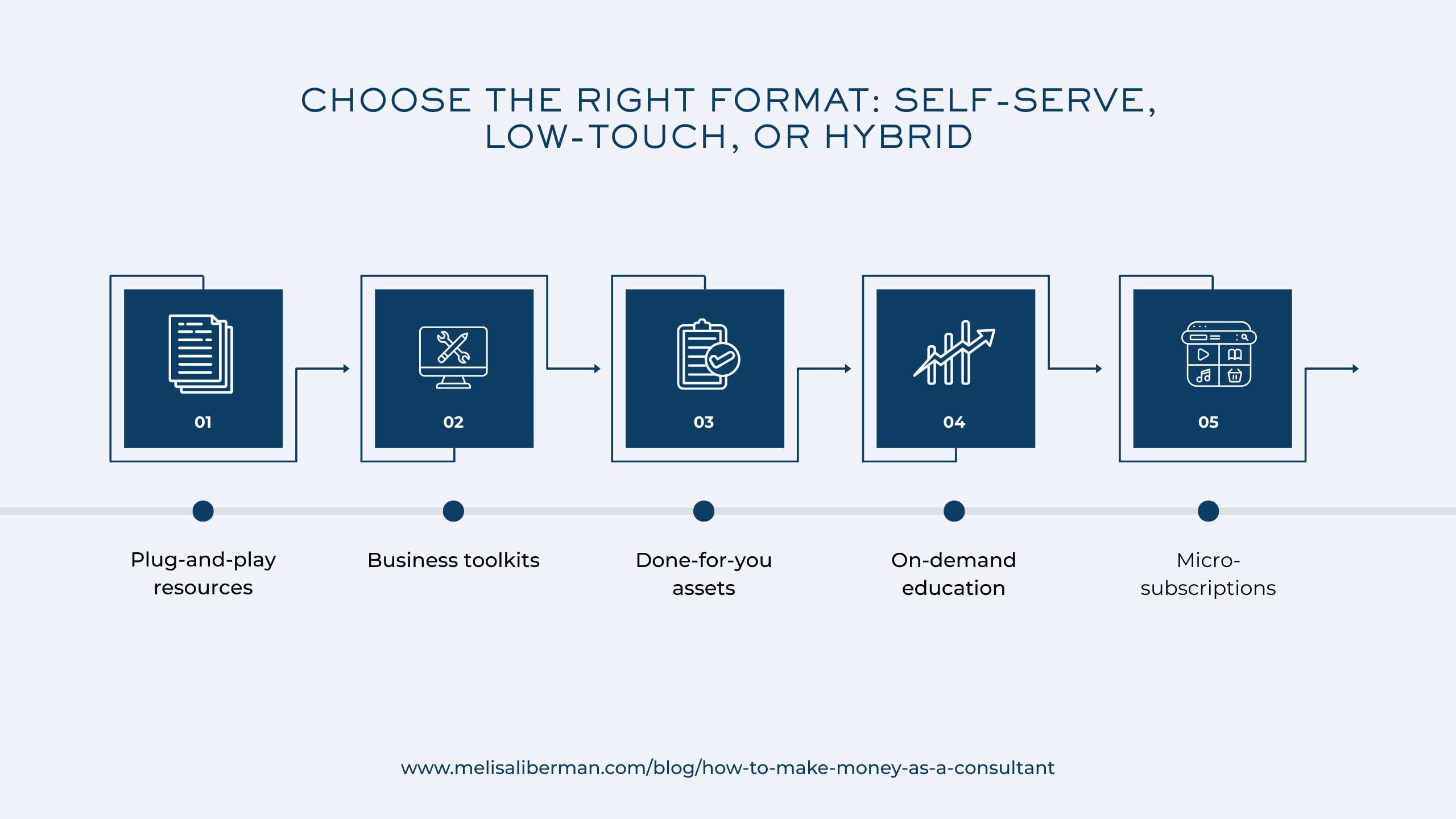
Different formats create different levels of effort and margin. A few that tend to work well for experienced consultants:
- Plug-and-play resources: templates, checklists, scripts, and swipe files clients can implement quickly. These often sell well because the value is immediate and concrete.
- Business toolkits: bundled assets that solve a full workflow, like a discovery toolkit, proposal toolkit, or onboarding kit. Toolkits feel more premium than single templates.
- Done-for-you assets: editable deliverables, frameworks, or playbooks a client can adapt internally. These can command higher prices because they save real time.
- On-demand education: workshops recorded once and sold repeatedly, or short courses tied to a specific outcome. Think “decision support in a box.”
- Micro-subscriptions: a small recurring membership for ongoing prompts, templates, or monthly office-hours replays. This can pair nicely with email monetization.
The common thread is that these are built for asynchronous delivery. The buyer can use them without scheduling you.
Build reusable frameworks so every product compounds
If you want scalable learning products, you need a core framework that can be reused across:
- Consulting engagements
- Training programs
- Templates and toolkits
- Content and emails
This is the compounding advantage. A strong framework makes curriculum development faster and increases conversion because your ideas feel cohesive, not like disconnected tips.
When you build a product, ask: what repeatable steps do I guide clients through in 1:1 work? That sequence is usually the spine of your reusable framework.
Automate sales with evergreen funnels, not launch chaos
You do not need to become an internet marketer to create predictable product sales, but you do need a basic system for automated sales. The simplest version is an evergreen funnel:
- A high-intent entry point (a lead magnet, a webinar replay, or a “starter toolkit”)
- A short email sequence that teaches and builds trust
- A clear offer page for a low-touch product
- A checkout and delivery system that runs without you
Evergreen funnels work best when the product solves a narrow, urgent problem. If you try to sell something broad, it requires more education and more touch.
Pick online course platforms based on operational ease
If you are selling on-demand education, choose online course platforms based on how easily they handle:
- Hosting and delivery
- Payments and taxes
- Email integration
- Customer access and support
Do not overbuild. The platform is not the differentiator, the clarity of the outcome and the usefulness of the assets are.
Use long-form content as the engine for content monetization
Most successful semi-passive offers are powered by content, especially long-form content that builds authority and search visibility. The key is connecting that content to a next step that makes sense.
Examples:
- A pricing article that naturally leads to a pricing toolkit
- A pipeline article that leads to an outreach swipe file
- A positioning article that leads to a messaging mini-course
This is content monetization done cleanly. The content earns attention, and the product captures value from the segment of readers who want implementation support.
Add a micro-subscription to stabilize product revenue
One-time purchases can be spiky. A small micro-subscription can smooth revenue and deepen trust over time. The best micro-subscriptions are narrow and deliver consistent value with minimal upkeep, for example:
- Monthly template drops
- Quarterly planning kits
- A curated email with practical teardown examples
- A resource library that grows over time
This also creates a natural client lifecycle path from low-touch to higher-touch offers.
Keep expectations realistic and protect your brand
Passive and semi-passive offers are still part of your business reputation. If the assets are shallow or generic, they can weaken your positioning. Focus on products that:
- Solve a real problem your ideal clients already pay to solve
- Are specific enough to implement without you
- Reflect your frameworks and standards
A good rule: if you would not feel comfortable using the asset inside a paid engagement, do not sell it.
The strategic win: low-touch revenue that feeds high-ticket work
The most valuable outcome of semi-passive income is not just extra money. It is leverage. Self-serve products can:
- Create inbound leads
- Pre-educate buyers
- Improve margins by reducing repeated explanations
- Build a pipeline of warm prospects for higher-ticket consulting
Done well, these offers are not a distraction. They are an ecosystem that makes your consulting business more resilient.
Building recurring revenue models
Recurring revenue is one of the cleanest ways to stabilize a consulting business. It smooths cash flow, reduces the pressure to constantly sell, and gives you space to make better strategic decisions. The goal is consistent revenue that is not dependent on always finding the next project.
For consultants, recurring revenue usually comes from one of three places: ongoing advisory, ongoing delivery, or ongoing access. The key is designing it intentionally so it stays profitable and does not become “unlimited support” disguised as a retainer.
Subscription consulting: Sell ongoing decision support, not endless work
Subscription consulting works best when clients need regular input, prioritization, and course correction. Think of it as a structured relationship where you provide ongoing guidance, not constant execution.
A strong subscription consulting model includes:
- A defined cadence (weekly, biweekly, or monthly)
- Clear deliverables or outcomes (decisions made, roadmap updated, risks flagged)
- Limits around access and response time
- A renewal rhythm that reinforces value
Subscription consulting becomes high leverage when you are paid for your judgment, not your labor.
Membership programs: Scale access without scaling 1:1 time
Membership programs are a version of recurring revenue where clients pay for access to resources, community, group sessions, or regular content. This model can work well if you serve a market with shared challenges and you can deliver value in a repeatable way.
What makes memberships work:
- A clear promise: what members will be able to do better
- Consistent delivery: predictable sessions or resource drops
- Strong boundaries: what is included, what is not
- A visible path: how members can upgrade into higher-touch services
Memberships are not a fit for every consultant, but they can be a powerful part of a broader service ecosystem.
Monthly service plans: Productize ongoing work
Monthly service plans are ideal when clients need ongoing execution, maintenance, or optimization. These plans are easiest to deliver when the work can be standardized.
Common examples include:
- Website care packages for ongoing updates, monitoring, and improvements
- Reporting services with monthly insights and recommendations
- Ongoing optimizations tied to performance goals
- Post-project support so the strategy does not die after delivery
This model is most profitable when the scope is tightly defined, delivery is templated, and you have a clear workflow.
Contract continuity: Make renewals the default, not an awkward ask
One of the biggest mistakes consultants make is treating continuity as a separate sales event. Contract continuity should be designed into the engagement from the beginning.
A few simple ways to do that:
- Include a “support and optimization” phase in your proposal as an option
- Build a transition milestone in your project plan that tees up the next phase
- Use an end-of-project review to define what success looks like over the next 90 days
When you normalize continuity early, clients are more likely to stay because it feels like the planned next step, not a surprise upsell.
Client retention systems: Retainers only work if clients feel momentum
Retention is not about being available. It is about being valuable repeatedly. Strong client retention systems make your recurring relationship feel active and worth the monthly fee.
A retention system usually includes:
- A monthly or quarterly planning touchpoint
- Visible tracking of wins, decisions, and progress
- Regular recommendations based on what you are seeing
- A simple “what’s next” roadmap so the relationship stays forward-moving
Clients cancel recurring services when they feel stalled or uncertain about value. Your job is to make value obvious.
Monthly billing: Make it easy to pay and easy to stay
Recurring revenue requires operational simplicity. Monthly billing should be clean and automatic. Whether you invoice monthly or use subscription payments, remove friction:
- Clear billing date and terms
- A defined minimum commitment where appropriate
- Transparent scope and service boundaries
- A process for pausing, upgrading, or adding scope
This makes the relationship feel professional and reduces administrative back-and-forth.
Offer priority access and support plans without creating chaos
Many consultants sell recurring revenue as priority access or “support plans.” This can work, but only if you set boundaries that protect your calendar.
Examples of smart boundaries:
- Defined response times (24 to 48 hours)
- A set number of touchpoints per month
- Asynchronous support via a shared doc or inbox
- “Escalation” rules for urgent requests
The goal is to give clients confidence they can reach you without creating an always-on expectation.
Recurring revenue is a design problem
If your recurring model feels draining, the issue is rarely the concept. It is the design. Recurring revenue works when:
- The client has an ongoing need
- You can deliver consistently with a repeatable system
- Scope is controlled
- Value is visible and refreshed regularly
Build recurring revenue around outcomes, cadence, and boundaries, and it becomes one of the most stable foundations you can create in a consulting business.
Why business owner identity matters if you want to make more money as a consultant
At a certain point, income stops being a tactics problem and starts being an identity problem. Many consultants do all the right things on paper, better pricing, stronger offers, clearer positioning, and still hit an income ceiling. The reason is simple: they are operating like highly skilled individual contributors, not like business owners.
This is the core shift behind the consultant vs business owner distinction. A consultant focuses on delivering great work. A business owner focuses on designing a system that turns great work into repeatable, scalable income.
Entrepreneurial identity determines your decision-making ceiling
Your entrepreneurial identity shapes how you make decisions under pressure. If you see yourself primarily as a practitioner, you optimize for doing the work well and staying busy. If you see yourself as an owner, you optimize for leverage, margin, and long-term value.
This shows up everywhere:
- Consultants ask, “Can I deliver this?”
- Owners ask, “Should this be the way revenue is generated at all?”
That difference compounds over time. Identity drives behavior, and behavior drives income.
Ownership mindset is what unlocks scaling potential
An ownership mindset changes how you think about time, energy, and tradeoffs. Instead of asking how to fit more work into your schedule, you ask how to redesign the business so revenue is less dependent on your availability.
This is where scaling potential actually comes from. Not from hiring prematurely or chasing complexity, but from:
- Choosing offers that can be delivered repeatedly
- Building systems instead of relying on memory
- Pricing for outcomes and margin, not effort
- Saying no to work that does not support the long-term model
Without this perspective, growth feels like more pressure instead of more freedom.
Strategy plus mindset sets your income ceiling
You cannot separate strategy + mindset. Strong strategy without an ownership perspective leads to underpricing, over-customization, and burnout. Strong mindset without strategy leads to vague confidence with no structural change.
This is why income plateaus often persist even after tactical improvements. The internal model of “how this business makes money” has not been updated.
A business owner asks different questions:
- Does this offer increase or dilute focus?
- Does this client move the business forward or just fill time?
- Is this revenue sustainable, or just impressive on paper?
Those questions shape the architecture of the business.
Business vision gives your decisions a filter
A clear business vision is not motivational fluff. It is a decision filter. When you know what kind of business you are building, choices around pricing, services, and growth get simpler.
Vision clarifies:
- What type of work you want more of
- What kind of revenue you are optimizing for
- What you are willing to say no to
- How much complexity you are willing to manage
Without vision, consultants default to short-term wins that quietly cap long-term income.
Profit mindset shifts focus from revenue to quality of revenue
A profit mindset moves you beyond top-line thinking. Revenue alone does not equal success if it comes with high delivery drag, constant availability, or fragile client relationships.
Owners pay attention to:
- Margin by offer
- Time cost of delivery
- Client concentration risk
- Revenue predictability
This is why two consultants can earn the same revenue and have completely different quality of life and growth potential.
The IC-Grow Method reframes growth as identity evolution
The IC-Grow Method is rooted in this idea: making more money as a consultant requires evolving from individual contributor to owner without abandoning expertise. You do not stop being good at your craft. You stop letting your craft be the bottleneck.
Growth happens when you shift your ownership perspective from “How do I get more clients?” to “How should this business generate income in a way that compounds?”
That shift is uncomfortable because it requires letting go of habits that once worked. But it is also where leverage lives.
Your income ceiling rises when your identity does
If you feel like you are doing everything right but not seeing the financial upside you expected, look at identity before tactics. The biggest gains often come not from doing more, but from deciding differently.
When you operate as a business owner, pricing changes. Offers change. Boundaries change. And over time, income follows.
Click here to take the Consulting Business Owner Mindset Audit.
Common mistakes that keep consultants from making good money
Most consultants who struggle financially are not inexperienced or unskilled. They are running into predictable consulting pitfalls that quietly cap income over time. These mistakes are easy to miss because they often look like “doing the right thing,” especially when you are client-focused and delivery-driven.
Below are the most common growth blockers I see, and why they matter.
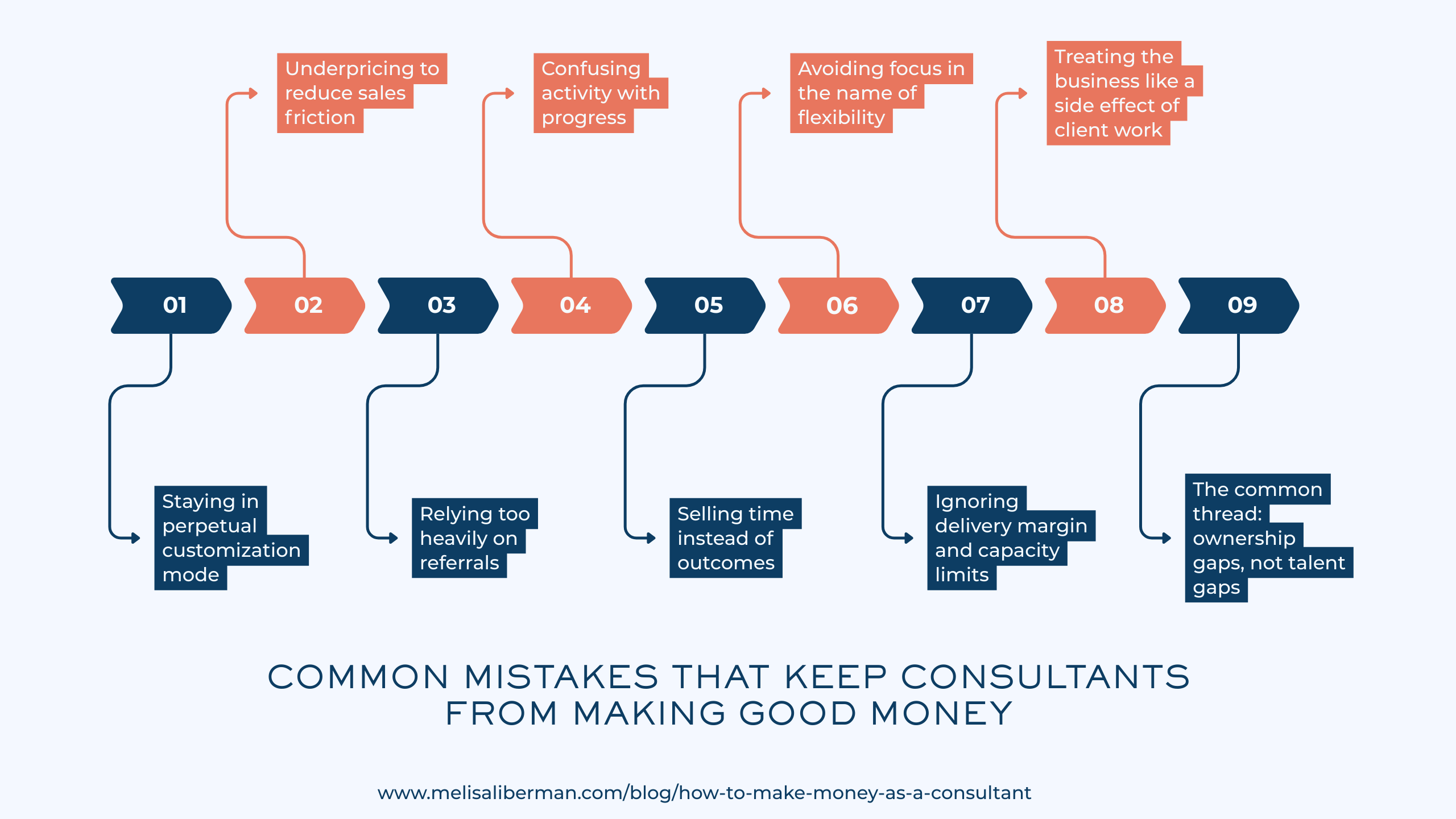
Staying in perpetual customization mode
One of the biggest business blind spots is believing that every client requires a fully custom solution. While some tailoring is necessary, full customization on every engagement makes your business fragile. It slows delivery, weakens margins, and makes pricing harder to defend.
Customization feels like high service. In reality, it often hides the lack of a clear offer structure. Consultants who make good money standardize the core and customize the edges.
Underpricing to reduce sales friction
Many consultants underprice as a way to avoid rejection or speed up decisions. This creates missed opportunities on multiple levels. Lower prices attract clients who are more price-sensitive, increase scope pressure, and reduce the margin you need to run the business properly.
Underpricing also trains clients to see your work as a commodity. Once that perception is set, it is difficult to raise rates without changing positioning.
Relying too heavily on referrals
Referrals are valuable, but overreliance on them is a hidden scaling challenge. When referrals slow down, revenue drops. When referrals surge, delivery gets overwhelmed.
Without a controllable lead generation system, growth becomes reactive. Consultants who earn well treat referrals as one channel, not the foundation of the business.
Confusing activity with progress
Being busy is not the same as building a profitable business. Many consultants fill their time with delivery, admin, and low-leverage tasks while avoiding higher-impact work like offer design, pricing strategy, and pipeline management.
This is a classic growth blocker. If all of your time is consumed by client work, there is no space to improve the business that generates that work.
Selling time instead of outcomes
Time-based thinking keeps income capped. When you sell hours instead of outcomes, you tie revenue directly to your availability and energy. This makes it difficult to scale, raise prices, or step back without income dropping.
Consultants who make good money shift the conversation toward results, decisions enabled, and risk reduced. That shift supports better pricing and stronger positioning.
Avoiding focus in the name of flexibility
Saying yes to everything feels flexible, but it often leads to dilution. Lack of focus weakens messaging, slows sales cycles, and makes it harder to build repeatable offers.
Focus is not limitation. It is leverage. Without it, your marketing stays vague and your services stay hard to explain.
Ignoring delivery margin and capacity limits
Strong revenue with weak margins is a dangerous illusion. Many consultants do not track how long work actually takes or how much cognitive load it creates. Over time, this leads to burnout and stalled growth.
If you do not understand your delivery costs, you cannot price intelligently or scale sustainably.
Treating the business like a side effect of client work
The most fundamental mistake is treating the business as something that happens around client work instead of something you intentionally design. This mindset creates long-term business blind spots around systems, pricing, and strategy.
Consultants who make good money run the business with the same rigor they bring to client engagements.
The common thread: ownership gaps, not talent gaps
These mistakes are rarely about intelligence or experience. They are about operating without an ownership lens. When you shift from reacting to designing, from delivering to structuring, many of these problems resolve naturally.
Identifying these pitfalls is not about self-criticism. It is about recognizing where small changes in approach can unlock disproportionate financial results.
The underpricing trap
Underpricing is one of the most expensive mistakes consultants make, and it rarely starts as a numbers problem. It usually starts as a fear problem. Fear of losing the deal. Fear of being judged. Fear that you will not be able to prove the value. Over time, that fear-based pricing becomes your default, and it quietly rewires what you think is possible.
The trap is that underpricing often “works” in the short term. You get the yes. You stay busy. You feel productive. But the long-term cost is steep: profit margin erosion, lower-quality clients, and a business that demands more and more effort for the same or less financial return.
How underpricing attracts the wrong type of client
When your fees are low relative to the value you deliver, you tend to attract low-fee clients who optimize for price, not outcomes. These clients are often harder to serve because:
- They scrutinize every line item
- They ask for more than what was agreed
- They are slower to make decisions
- They treat your expertise like a commodity
This is not about judging clients. It is about recognizing how price shapes behavior. Low fees create a dynamic where the client feels entitled to more access, and you feel pressure to over-deliver to “make it worth it.”
Self-worth and pricing are connected, but the fix is structural
There is a real relationship between self-worth and pricing, but it is not solved by repeating affirmations. Most consultants struggle to charge appropriately because their offer boundaries are unclear, or because they are pricing based on effort rather than impact.
If your scope is fuzzy, your confidence drops. When confidence drops, you discount. This is a structural loop, not a personal failing.
A more useful reframe is: your price is not a statement about your worth as a human. It is a business decision about the value of an outcome and the cost of delivering it well.
Value misalignment shows up as resentment and overwork
Underpricing creates value misalignment. You feel the gap between what you are being paid and what you are contributing. That gap often turns into:
- Resentment toward the client
- Second-guessing your business
- Overwork to compensate
- Avoidance of sales because you do not want another underpaid engagement
This is one reason underpricing is so corrosive. It does not just reduce revenue, it reduces energy and willingness to market.
The hidden cost: profit margin erosion that makes growth impossible
Even if revenue looks okay, underpricing erodes margin. You have less room for:
- Time off and recovery
- Business development
- Tools, support, or subcontractors
- Investing in your own growth
That profit margin erosion keeps you stuck at a certain level of capacity. You cannot scale because there is no cushion to redesign how the business runs.
Signs you are in the underpricing trap
A few patterns to watch for:
- You feel relief when a client accepts your proposal, but dread delivering it
- You frequently expand scope “to be helpful”
- You avoid raising rates because it feels like a personal risk
- Your calendar is full, but your bank account does not reflect it
- You keep attracting clients who negotiate aggressively or delay payment
These are not random issues. They are symptoms of a pricing foundation that is too low for the value you deliver.
How to get out of the trap without blowing up your pipeline
Getting out of underpricing does not require a dramatic overnight doubling of rates. It requires tightening your structure and resetting expectations.
Practical steps:
- Set a minimum acceptable rate and stop taking work below it
- Standardize the core of your offer so scope is clear
- Introduce tiers so clients can self-select without discounting
- Anchor pricing ranges early to frame the conversation
- Tie your fee to outcomes with simple ROI logic, not effort
Most importantly, stop treating lower pricing as a shortcut to certainty. It is a shortcut to instability.
The ownership shift: price to protect the business you are building
Underpricing is often the result of operating like a service provider trying to be chosen, instead of a business owner designing a profitable model. When you price appropriately, you are not being aggressive. You are protecting your capacity, your standards, and your ability to deliver excellent work.
That is what sustainable pricing does. It funds the business, not just the next project.
Click here to read the article on How Independent Consultant Rates and Retainers Work.
Over-reliance on referrals and word-of-mouth
Referrals and word-of-mouth are often framed as the gold standard of consulting growth. They feel validating and they usually bring in warm, well-qualified clients. The problem is not the channel. The problem is referral dependency. When referrals are your primary or only source of new work, your business is exposed to forces you do not control.
This shows up most clearly as pipeline volatility. Work comes in waves. One month you are overbooked. The next month you are staring at a lead drought wondering what changed.
Why referrals create inconsistent leads
Referrals are episodic by nature. They depend on timing, budget cycles, and whether someone happens to think of you at the right moment. Even happy clients do not refer consistently because:
- They may not recognize when someone needs your help
- They may hesitate to “risk” their relationship
- They may forget what you actually do in detail
- Their own priorities change
The result is inconsistent leads that make revenue hard to predict.
The hidden scaling limitations of referral-only growth
Referral-based businesses scale slowly and unevenly. As long as you are small and flexible, this may feel fine. But over time, scaling limitations appear:
- You cannot reliably plan capacity or hiring
- You struggle to raise prices because deal flow feels fragile
- You say yes to misaligned work out of fear of gaps
- You stay reactive instead of strategic
This is why many experienced consultants feel “stuck” even with strong reputations. The growth engine is informal and opaque.
Referral dependency shifts power away from you
When referrals are your only channel, control moves outward. Your income depends on other people’s memory, generosity, and networks. That is not a stable operating model.
This does not mean you stop valuing referrals. It means you stop building a business that requires them to function.
Why word-of-mouth alone limits positioning
Word-of-mouth often compresses your positioning into something vague, like “they are really smart” or “they helped us with X.” Without intentional messaging and visible authority, referrals tend to:
- Anchor you to past work instead of future offers
- Undersell the full scope of what you do
- Attract requests that are adjacent but not ideal
This makes it harder to evolve your services or move upmarket, because the market perception lags behind your actual capabilities.
The fix: turn referrals into one input, not the engine
A healthier model treats referrals as a bonus on top of a controllable system. That system usually includes:
- A clear niche and problem focus
- Visible authority through content or speaking
- A repeatable outbound or partnership channel
- A pipeline you review and manage weekly
When these are in place, referrals increase in quality and impact because they land in a business that can absorb them predictably.
How to reduce pipeline volatility without becoming salesy
You do not need to become aggressive or inauthentic to move beyond referrals. You need structure:
- Decide how many new conversations you want per month
- Choose one proactive channel to support that goal
- Track outreach and follow-up so nothing relies on memory
- Keep light business development running even when busy
This is how you avoid the boom-and-bust cycle.
Referrals should reward a strong system, not replace one
The most stable consulting businesses still receive referrals. The difference is that referrals sit on top of a system that already works. When a referral comes in, it accelerates growth instead of rescuing it.
If your pipeline lives or dies by word-of-mouth, that is a signal to build infrastructure, not to hustle harder.
Click here to read How to Get Consulting Clients With This Weekly Routine.
Operating without business development systems
If your pipeline depends on whenever you have time, you do not have a pipeline. You have hope. Many consultants operate this way for years, especially when they are busy delivering work. Then a project ends, referrals slow down, and the business hits a predictable wall: there is no lead engine to create momentum on demand.
This is one of the most common BD bottlenecks I see. Not because consultants are lazy or unaware, but because business development feels secondary to client delivery. The issue is that when BD is treated as optional, revenue becomes volatile by default.
What it looks like when there is no system
Operating without business development systems usually shows up as:
- Random outreach when revenue feels tight
- A scramble to “post more on LinkedIn” without a plan
- Leads tracked mentally, or not tracked at all
- Proposals and follow-ups happening inconsistently
- Long gaps between visibility and actual sales conversations
In other words, lots of effort, very little compounding.
Manual processes create invisible drag
When your BD process is entirely manual, every lead requires more mental energy than it should. You are rewriting messages, rebuilding lists, and reinventing follow-up every time. That drag is why BD gets postponed.
Manual does not mean wrong, but it does mean you need structure. Even a simple system can reduce friction dramatically:
- A target list that you update monthly
- A few proven message templates
- Defined follow-up timing
- A weekly pipeline review
Without those, business development becomes a series of one-off tasks that never turn into an engine.
Lack of structure makes follow-up unreliable
Most consultants lose opportunities not because prospects say no, but because no one follows up at the right time. When there is a lack of structure, follow-up depends on memory and motivation, which are terrible systems.
A real BD system makes follow-up automatic:
- Every opportunity has a next step
- Every next step has a date
- Every date gets reviewed weekly
That is how you turn “maybe later” into future revenue.
The real cost is decision fatigue and inconsistent results
When BD is improvised, you are constantly making small decisions:
- Who should I reach out to?
- What should I say?
- Where should I post?
- Should I follow up now or wait?
This decision fatigue is why consultants swing between bursts of outreach and long periods of silence. The result is inconsistent lead flow and inconsistent income.
Build a simple lead engine that runs in the background
A functional lead engine does not have to be complicated. It just needs repeatable inputs.
A simple model that works for many consultants:
- One visibility activity weekly (a post, email, or short case story)
- One outbound block weekly (targeted reach-outs and follow-ups)
- One relationship touchpoint weekly (partners, former clients, connectors)
- One pipeline review weekly (move deals forward)
This turns BD into a routine rather than a crisis response.
Systems remove the “salesy” feeling
Many consultants avoid structured BD because they associate it with aggressive selling. A system actually does the opposite. It makes your outreach more focused, more relevant, and less frantic.
When you know who you serve, what problem you solve, and what your next step is, business development becomes a professional process, not a personality performance.
The ownership reframe: your pipeline is a business asset
If you want consistent revenue, you need to treat business development like an operating system. Not something you do when you have time, but something that protects the business from volatility.
Client work is your output. Business development systems are what ensure you have output to deliver in the first place.
Click here to download the CRM Configuration Guide for Consultants.
Staying too general instead of positioning as an expert
If you feel like you are doing solid work but clients still treat you as interchangeable, there is a good chance the issue is positioning. Staying too general creates the illusion of a bigger market, but it usually produces smaller results. A broad message leads to brand confusion, weaker trust, and downward pressure on pricing.
This is one of the most common consulting pitfalls because it feels safe. When you are general, you can say yes to more opportunities. The tradeoff is that you become harder to remember and harder to refer.
Why lack of focus reduces revenue
A lack of focus forces prospects to do extra work to understand whether you are for them. Most will not. They will either move on or default to comparing you on price.
Specific positioning shortens the sales cycle because the right buyer can self-identify quickly. It also makes your marketing more efficient, because you are speaking directly to a defined set of problems rather than broadcasting generic competence.
Niche dilution creates undifferentiated offers
Many consultants believe “niche” means picking an industry and committing forever. In reality, niche is about clarity, not restriction. It is the intersection of:
- A specific type of client
- A specific problem
- A specific outcome
- A repeatable approach
When you avoid that clarity, you get niche dilution. Your services blur together into undifferentiated offers like “strategy support” or “business consulting.” That language does not communicate value. It communicates vagueness.
Brand confusion makes referrals and marketing harder
People refer what they can explain. If your positioning requires a long conversation, referrals dry up or become misaligned. This is how brand confusion shows up in real life:
- Referrals come in for work you do not want
- Prospects ask, “So what exactly do you do?”
- Discovery calls start with education instead of diagnosis
- Your content attracts peers, not buyers
When your positioning is sharp, your network becomes a distribution channel. When it is vague, your network becomes a slow drip of random leads.
Generalists often struggle to build authority
Low authority is not about being unknown, it is about being non-specific. Authority is built through repeated association with a clear problem space. When you are positioned as the person who solves a particular kind of problem, you become the default choice in that category.
If you are positioned as “helpful for many things,” you can still get clients, but you are less likely to command premium fees because the value is harder to quantify.
How to tighten positioning without boxing yourself in
You do not need to eliminate flexibility. You need a clear front door.
Practical ways to reduce generality:
- Choose one primary problem you want to be known for solving
- Name the buyer and the moment they realize they need help
- Define your signature approach or framework
- Package your offer with a clear outcome and scope boundaries
You can still do adjacent work. You just do not lead with it. The market needs one clear reason to hire you.
The payoff: clearer messaging, higher fees, better-fit work
Positioning as an expert does three things that directly increase income:
- It improves lead quality because the right clients self-select
- It increases close rates because trust is higher earlier
- It supports premium pricing because you are not competing as a commodity
This is not about pretending to be an expert. It is about claiming the expertise you already have and expressing it with clarity.
Failing to build recurring revenue streams
One of the fastest ways to create stress in a consulting business is relying entirely on one-off projects. Even when those projects pay well, the income pattern is uneven. You finish a project, invoice, deliver, and then immediately need to sell again. This is how inconsistent income becomes the default, not because demand is low, but because the revenue model resets to zero after every engagement.
Without recurring revenue, growth is fragile. Every month starts with pressure.
One-off projects create built-in revenue instability
One-off projects are not inherently bad. They are often how consultants start and they can be highly profitable. The issue is when they are the only way money comes in.
A project-only model creates revenue instability because:
- Cash flow spikes and drops unpredictably
- Sales effort is constant, even when delivery is full
- Long gaps appear between invoiceable milestones
- Planning becomes reactive instead of strategic
This instability forces short-term decisions that undermine long-term growth.
Cash flow gaps limit strategic options
Cash flow gaps change how you operate. When income is uncertain, consultants are more likely to:
- Accept misaligned work
- Delay raising prices
- Avoid investing in systems or support
- Overwork to compensate for uncertainty
Even if total annual revenue looks fine, unpredictable timing creates stress and poor decision-making.
Retainer neglect is often a design failure, not a market failure
Many consultants say retainers “do not work” in their market. In reality, retainer neglect is usually the result of unclear value, weak scope boundaries, or poor positioning.
Clients will pay recurring fees when:
- There is an ongoing problem to solve
- The value of continuity is clear
- The scope is defined and predictable
- The engagement feels active, not passive
If your retainer offer is “access to me” without structure, it is hard to sell and even harder to sustain.
Why consultants avoid recurring models, even when they want stability
Recurring revenue requires a shift in how you think about delivery. Instead of completing work and moving on, you commit to an ongoing relationship. That can feel risky if you are not confident in your boundaries or your systems.
Common fears include:
- Getting stuck in low-value support
- Being overcommitted long-term
- Losing flexibility
- Underpricing ongoing work
These fears are valid, but they are solvable with better design.
How to introduce recurring revenue without overcommitting
You do not need to overhaul your business to add recurring income. Start by extending what already works.
Practical entry points:
- Add a post-project support phase with a clear cadence
- Offer ongoing advisory tied to quarterly goals
- Package monthly reporting and recommendations
- Create a subscription or membership for ongoing guidance
The key is making the recurring component a natural continuation, not a separate pitch.
Design recurring offers around momentum and visibility
Recurring revenue works when clients feel progress. That means:
- Regular touchpoints with purpose
- Visible tracking of decisions and outcomes
- Proactive recommendations, not reactive support
- Clear renewal checkpoints
When clients can see the value monthly, the relationship feels justified.
Stability comes from systems, not hope
Failing to build recurring revenue keeps your business locked in a cycle of constant selling and delivery pressure. Adding even one well-designed recurring offer can dramatically reduce stress and increase planning confidence.
Recurring revenue is not about locking clients in. It is about building continuity into how you create value.
Poor expense management and financial planning
You can be good at sales, delivery, and pricing and still feel financially unstable if your money management is weak. This is one of the least discussed but most damaging issues in consulting. Poor financial habits create cash flow issues that have nothing to do with demand and everything to do with visibility and discipline.
When finances feel unclear, every business decision feels riskier than it should.
Why revenue alone does not prevent cash flow issues
Many consultants assume that earning more will automatically fix money stress. In reality, higher revenue without structure often magnifies problems. Overspending increases, margins get squeezed, and uncertainty grows because no one is tracking what is actually available.
Cash flow problems usually come from timing and planning, not from lack of income:
- Large invoices paid late
- Lumpy project-based revenue
- Fixed expenses that do not flex with workload
- No buffer for slow months
Without planning, these issues repeat even as revenue increases.
Financial blind spots are common in service businesses
Consulting businesses are deceptively simple, which creates financial blind spots. There is no inventory and few hard costs, so it is easy to assume things are “fine” as long as money is coming in.
Common blind spots include:
- Not separating personal and business finances cleanly
- Ignoring true delivery costs, including time
- Forgetting to budget for taxes
- Treating irregular expenses as surprises instead of planning for them
These gaps make it hard to see whether the business is actually profitable.
Overspending often follows growth, not failure
Overspending is frequently triggered by growth. New tools, subscriptions, contractors, and marketing experiments pile up quickly. Individually, they seem small. Collectively, they erode margin.
This is especially dangerous when spending decisions are made emotionally, for example to reduce stress, buy speed, or “look more professional,” without clear ROI.
Spending should follow strategy, not anxiety.
Emergency unpreparedness increases stress and poor decisions
A lack of reserves creates emergency unpreparedness. When there is no buffer, any disruption becomes a crisis:
- A delayed payment
- A paused project
- A client churn event
- An unexpected tax bill
This forces reactive decisions, like taking underpriced work or delaying necessary investments. A modest cash reserve changes the entire tone of the business.
Budget mismanagement is usually about avoidance, not ignorance
Most consultants are capable of managing a budget. Budget mismanagement tends to come from avoidance. Finances feel uncomfortable, so they are not reviewed regularly. That discomfort compounds over time.
A simple monthly rhythm can prevent this:
- Review income received and projected
- Review fixed and variable expenses
- Set aside tax and savings amounts first
- Decide intentionally what is left to spend
This turns finances from a source of stress into a decision-making tool.
Financial clarity supports better pricing and growth decisions
When you understand your numbers, you price more confidently, plan capacity realistically, and invest with intention. Financial clarity supports:
- Setting minimum acceptable rates
- Knowing when to say no
- Deciding which offers are worth expanding
- Identifying where margin is leaking
Without it, growth is guesswork.
Treat financial planning as part of ownership, not admin
Expense management and planning are not busywork. They are part of the ownership mindset. A well-run consulting business does not just generate revenue. It converts that revenue into stability, optionality, and long-term value.
You do not need complex forecasts or perfect spreadsheets. You need visibility, consistency, and the willingness to look at the numbers regularly.
Designing a consulting business that compounds over time
One of the most overlooked factors in consulting income is intentional review and iteration. Many consultants build their business once, then operate it on autopilot for years. Markets change. Buyer expectations shift. Your own capacity and priorities evolve. If the business model does not evolve with you, income stagnates even when demand exists.
Regularly stepping back to audit your offers, pricing, delivery load, and pipeline health is not optional if you want sustained growth. This does not require constant reinvention. It requires periodic, structured reflection. What is working well. What feels heavier than it should. Where margin is shrinking. Where demand is pulling you forward.
Another often-missed lever is decision discipline. Consultants frequently know what they should change, but delay acting because the current setup is “good enough.” That hesitation compounds. Small compromises around pricing, scope, or client fit tend to lock in patterns that are hard to unwind later. Strong businesses are built by making slightly uncomfortable decisions earlier than feels necessary.
It is also worth naming the role of energy and attention. Income growth is not only about smarter strategy, it is about where your best thinking time goes. When all of your energy is consumed by delivery, there is little left for design, improvement, or leverage. Protecting time to work on the business is a revenue decision, not a luxury.
Finally, remember that no single tactic fixes everything. Pricing, positioning, lead generation, delivery, and mindset are interconnected. When something feels stuck, the answer is rarely “try harder.” It is usually “redesign the system.” That is the throughline across every section of this article.
If you want to make more money as a consultant, focus less on chasing the next opportunity and more on building a business that converts opportunity into stable, well-earned income over time.
Click here to take the Consultant’s Business Health 14-Point Assessment.
Get expert support to earn more as an independent consultant
At some point, reading and implementing on your own becomes slower than getting the right support. When you are already experienced, the biggest gains come from tightening strategy, correcting blind spots, and building systems that actually fit how you work. This is where targeted support can dramatically shorten the path to higher income and better business design.
If you want to keep learning while refining your thinking, the Grow Your Independent Consulting Business podcast is a strong place to start. It breaks down real consulting growth decisions in practical terms, without hype or generic advice. Use it to pressure-test your assumptions and spot patterns you may be too close to see clearly.
For consultants who want concrete assets and frameworks, the IC Toolkit and Growth Atlas tools are designed to turn strategy into execution. These resources help you move faster by giving you proven structures for pricing, positioning, pipeline management, and offer design, so you are not rebuilding from scratch every time.
If your biggest constraint is lead flow, the Consultant’s Pipeline Sprint provides a focused, time-bound way to build momentum. It is designed to help you implement a repeatable pipeline process rather than relying on referrals or bursts of inconsistent outreach.
For deeper, personalized support, IC-Grow Private Coaching is designed for consultants who want direct guidance on pricing, offers, and business model decisions. This is especially valuable when you are navigating inflection points, like moving upmarket, introducing recurring revenue, or restructuring how your services are delivered.
If you value peer perspective alongside expert guidance, the Sought-After Consultant Mastermind offers a structured environment to think like an owner, not just a practitioner. Being in the room with other experienced consultants accelerates learning and helps normalize the challenges that come with building a more profitable, sustainable business.
The common thread across all of these options is simple: you do not need more tactics. You need clarity, structure, and support that matches your level of experience. With the right guidance, earning more as an independent consultant becomes less about pushing harder and more about designing smarter.

About