How to Write an Independent Consultant Resume that Wins Clients
Dec 24, 2025
Estimated Reading Time: 13 minutes
Download the article as a PDF:

Table of contents
- What you will learn in this article
- What is an independent consultant resume and how is it different?
- Should independent consultants rely on resumes to win business?
- What clients look for in an independent consultant resume
- How to write an independent consultant resume
- Top skills to include on an independent consultant resume
- How to tailor your resume for each opportunity
- How to list your independent consulting experience on a resume
- How to format your independent consultant resume
- Independent consultant resume template (free download)
- Independent consultant resume examples (good vs. bad)
- Common mistakes to avoid on your independent consultant resume
- Frequently asked questions about independent consultant resumes
- Get expert help building a strong consultant brand and pipeline
What you will learn in this article
Independent consultants often default to creating a resume because it feels familiar. That instinct usually comes from employee thinking, not from what actually wins consulting work. This article explains when an independent consultant resume is useful, when it is not, and what clients are really evaluating when they ask for one.
You will learn the difference between employee resumes and consulting marketing assets, including one-pagers, capability decks, and portfolios. We will walk through how to position project-based work, outcomes, and specialization without overselling or violating client confidentiality.
This article also reflects real-world consulting scenarios, including RFPs, procurement processes, agency placements, and transitions back into employment. The goal is to help you make deliberate decisions about resumes as compliance tools, not confuse them with growth or authority-building assets.
What is an independent consultant resume and how is it different?
An independent consultant resume is often misunderstood. It is not a job application tool designed to signal promotability or cultural fit. In consulting contexts, a resume is usually a documentation artifact that summarizes project-based work, areas of expertise, and credibility indicators for third parties.
The biggest difference between an employee resume and a consulting resume is intent. An employee resume markets potential. A consulting resume documents past performance and scope so others can assess risk. Independent consultants sell outcomes, not availability.
This distinction matters because many consultants unintentionally dilute their positioning by presenting themselves like candidates rather than solution providers. A self-employed resume format should emphasize engagements, results, and specialization, not job descriptions or internal responsibilities.
Resume vs. consulting capability deck vs. website vs. LinkedIn
These assets serve different functions and should not be treated as interchangeable.
A consulting portfolio or capability deck is a sales asset. It frames problems you solve, outcomes you deliver, and the types of clients you work with. A personal website establishes authority and narrative control. LinkedIn functions as a discovery and credibility layer.
A resume, by contrast, is static documentation. It is rarely persuasive on its own. Independent consultants who rely on resumes instead of professional branding tools often struggle to differentiate themselves because resumes are not designed to communicate value or strategy.
High-performing consultants lead with portfolios, one-pagers, and case narratives, and keep resumes in reserve for situations that require formal documentation.
Click here to download a Consulting One-Pager template.
Why independent consultants may (or may not) need a resume
Most independent consultants do not need a resume to win clients. Referral-based business, direct outreach, and authority-driven inbound rarely involve resumes.
However, resumes still appear in certain client acquisition tools and workflows. Procurement teams, staffing agencies, and enterprise supplier systems often require resumes as part of their vetting or onboarding process.
The key mindset shift is this: a resume is not a growth strategy. It is a compliance artifact. Treating it as sales collateral leads to confusion and weak positioning.
Situations where having a resume actually matters
There are specific scenarios where having a clean, accurate consulting resume is useful, even necessary.
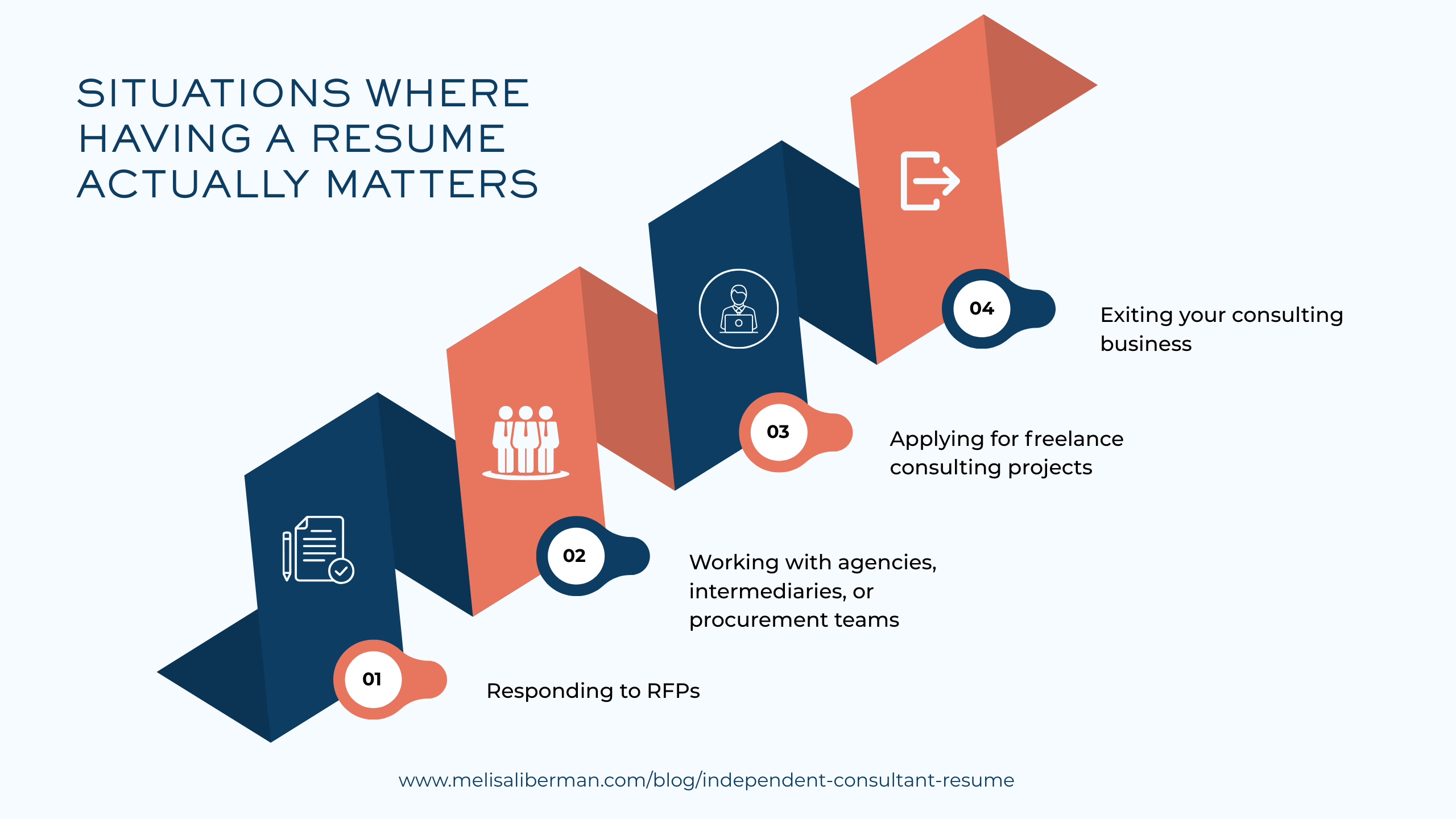
Responding to RFPs
In formal request for proposal processes, resumes are often required as part of contract bidding. They function as supporting documentation alongside the proposal, not as the main persuasive asset.
In these cases, the resume should align with the proposed scope of work, highlight relevant project experience, and reinforce credibility without restating the proposal itself. Think of it as evidence, not argument.
Working with agencies, intermediaries, or procurement teams
Staffing agencies, intermediaries, and enterprise procurement teams operate inside rigid systems. Vendor qualification processes often require resumes for background checks, intermediary vetting, and agency onboarding.
Here, the resume serves the agency, not the end client. It helps them categorize, submit, and defend you internally. Optimizing for clarity and relevance matters more than storytelling.
Applying for freelance consulting projects
Some freelance platforms and recruiter-led consulting projects still require a contractor resume as a proposal attachment. In these contexts, resumes help match you to project briefs quickly.
A concise, project-based resume format works best. It allows recruiters to scan for alignment without interpreting a long career narrative.
Exiting your consulting business
If you plan to re-enter employment or pursue a hybrid career path, you will eventually need an employment resume. This is a different document with different goals.
Consultants who anticipate this transition should maintain a version of their resume that translates consulting outcomes into language hiring managers understand, without undermining their consulting positioning in the meantime.
Should independent consultants rely on resumes to win business?
Short answer: no.
Independent consultants who rely on resumes to generate consulting leads are usually operating from employee thinking, and looking for staff augmentation-type roles. Resumes do not establish authority, communicate differentiation, or build trust.
Clients choose consultants based on reputation, referrals, demonstrated expertise, and confidence in outcomes. Documentation comes later, if at all.
The argument against resumes: “If they ask, you haven’t established authority”
When a prospective client asks for a resume early in the conversation, it often signals that authority has not yet been established. They are looking for reassurance instead of alignment.
Strong authority positioning reduces the need for documentation. Thought leadership, clear positioning, and relationship-based selling create trust before paperwork enters the picture.
This does not mean resumes are bad. It means they are reactive tools, not proactive ones.
When asking for a resume is reasonable or expected
There are reasonable exceptions. Corporate procurement, government contracts, freelance platforms, and intermediary partnerships all operate on standardized processes.
In these environments, resumes are expected regardless of authority. The mistake is assuming those environments represent how most consulting business is won.
Balancing authority, credibility, and practical requirements
Effective consultants balance credibility indicators with strategic restraint. They build authority through content, conversations, and results, while maintaining a resume that satisfies practical requirements when needed.
This approach keeps the resume in its proper role: supportive, not central.
What clients look for in an independent consultant resume
When clients or intermediaries review an independent consultant's resume, they are scanning for risk signals, not inspiration.
They want to see domain expertise, relevant experience, and evidence that you have delivered outcomes in similar contexts. They are less interested in titles, tenure, or internal responsibilities.
Client-centric language matters. Framing work around problems solved and results achieved makes the resume easier to evaluate.
Communicating credibility, impact, and specialization
Credibility comes from specificity. Listing industries, types of engagements, and strategic focus areas helps reviewers quickly assess fit.
Specialization signals maturity. Generalist resumes often feel interchangeable, while focused resumes imply repeatable success.
Showcasing results without overselling or violating NDAs
Most consultants operate under client confidentiality constraints. That does not mean results cannot be communicated.
Use anonymous case examples, aggregated metrics, and outcome-focused language. For example, reference percentage improvements, scale of impact, or scope of transformation without naming the client.
How to write an independent consultant resume
Writing a consulting resume starts with accepting its role. This is not a branding document. It is a structured summary of self-employment experience and value articulation.
A project-based resume format usually works best. It reflects how consulting work actually happens and avoids employee-style chronology.
What to include: the essential building blocks
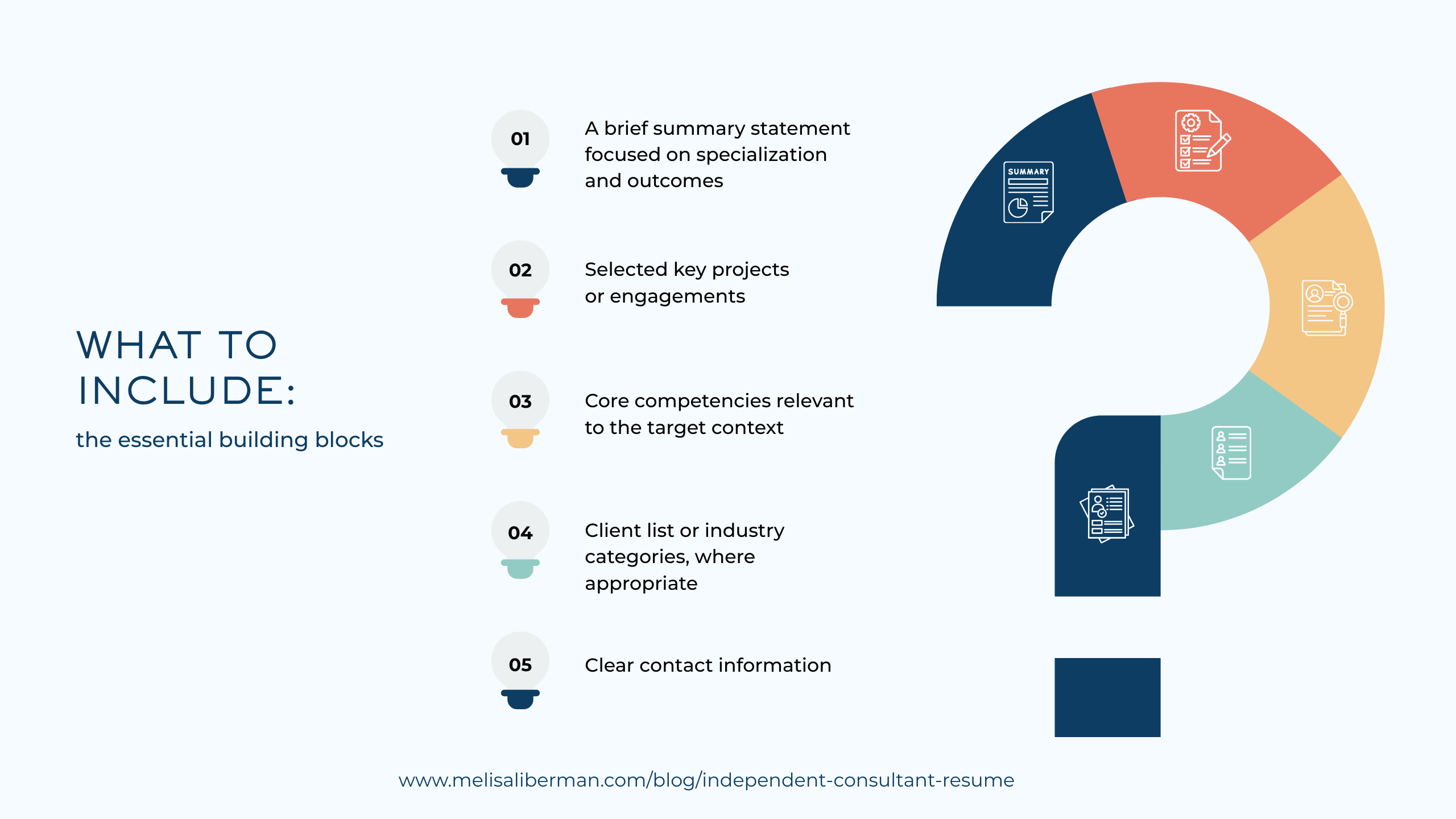
An effective independent consultant resume typically includes:
- A brief summary statement focused on specialization and outcomes
- Selected key projects or engagements
- Core competencies relevant to the target context
- Client list or industry categories, where appropriate
- Clear contact information
Avoid filler sections that exist only because they appear on employee resumes.
Highlighting core skills, achievements, and impact
Focus on achievements, not activities. Tie skills to outcomes using ROI metrics, efficiency improvements, or strategic initiatives where possible.
This reinforces that your value lies in results, not execution alone.
Listing clients, industries, and roles strategically
Be selective. Not every client or project belongs on the resume. Choose examples that reinforce your positioning and target market.
Industry categories and consulting roles help reviewers quickly understand where you fit.
Should you include a bio or professional summary?
A short executive-style summary can be useful if it clearly states your value proposition and strategic focus.
Avoid narrative bios. This is not the place for career storytelling. Clarity beats personality in this format.
Top skills to include on an independent consultant resume
Skills on a consulting resume should support credibility, not inflate scope.
Strategic thinking, project management, data analysis, and stakeholder engagement are common expectations, but they must be contextualized through outcomes.
Core consulting skills clients expect to see
Clients expect problem solving, business analysis, clear client communication, and the ability to synthesize recommendations.
If you facilitate workshops or lead decision-making processes, include that as evidence of seniority.
Industry-specific and technical capabilities
Technical skills matter when they are relevant to the engagement. SaaS consulting, healthcare compliance, ERP implementation, and financial modeling are examples where specificity increases trust.
Generic technical lists reduce credibility.
Soft skills that signal maturity and leadership
Executive presence, adaptability, emotional intelligence, and decision-making signal that you can operate at senior levels.
These should be demonstrated through examples, not listed as traits.
How to tailor your resume for each opportunity
Customization is about relevance, not reinvention.
Adjust emphasis, language, and project selection to align with the role, industry, or specialized requirement without rewriting the entire document.
Adapting to roles, industries, and specialized requirements
Mirror industry keywords and role-specific language where appropriate. This helps with both human review and ATS systems without compromising clarity.
Mapping experience to outcomes and value
Use outcome-driven language. Focus on business impact and client benefit rather than internal deliverables.
This reinforces your positioning as an outcome-focused consultant.
Customizing keywords and phrasing without overdoing it
Natural keyword use matters. Over-optimization makes resumes harder to read and less credible.
Prioritize clarity and tone consistency.
How to list your independent consulting experience on a resume
How you structure your consulting experience shapes how it is perceived.
Treat your consulting work as a business, not a gap or side activity.
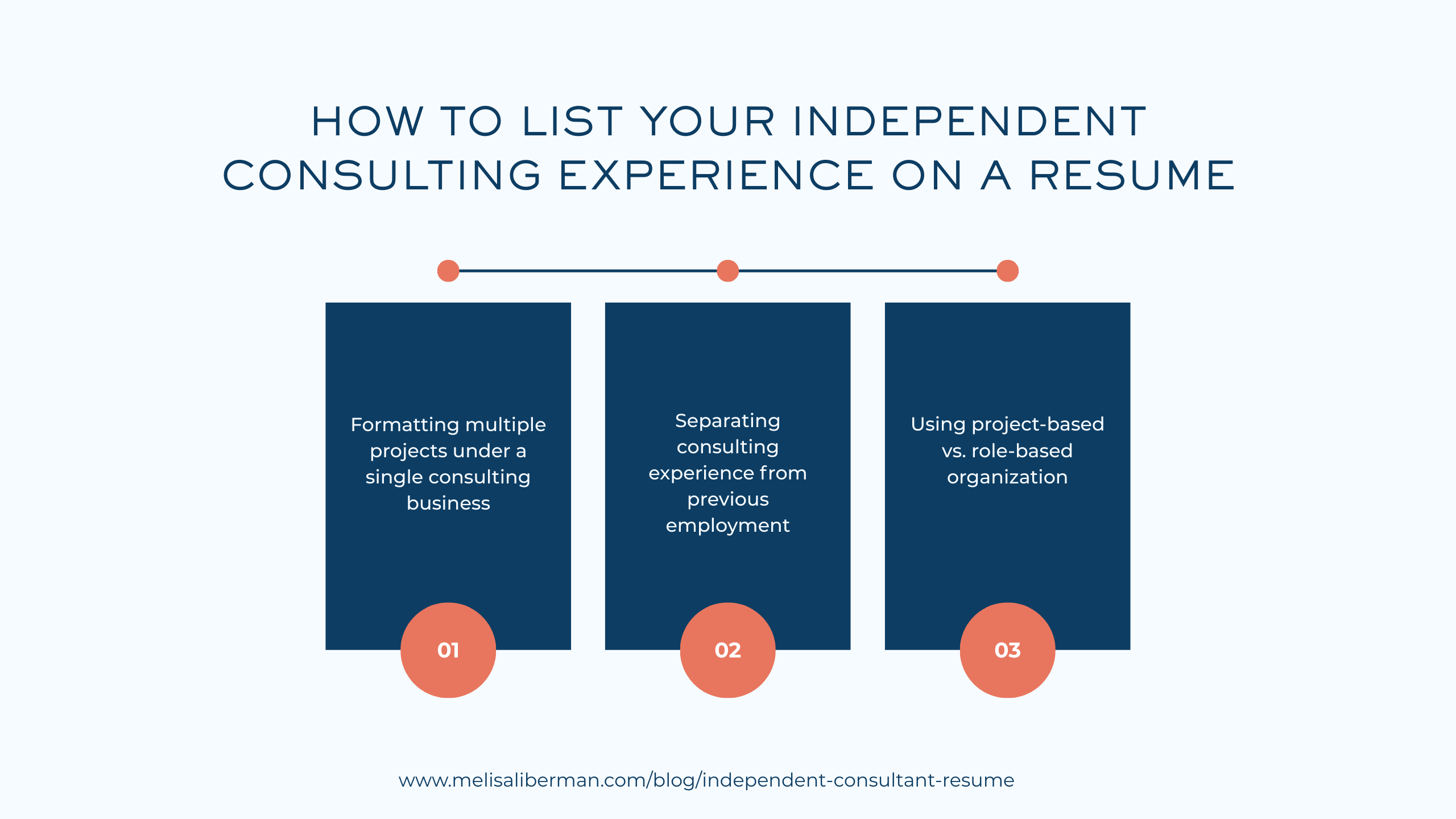
Formatting multiple projects under a single consulting business
Use an umbrella format with your business name, followed by selected projects. Maintain timeline consistency and role clarity.
This reinforces firm branding and professionalism.
Separating consulting experience from previous employment
A dual-section layout helps distinguish employment history from consulting work. This supports a coherent career narrative without blending the two.
Using project-based vs. role-based organization
Project-centric resumes align better with consulting reality. Hybrid formats can work if roles varied significantly.
Choose the structure that best reinforces your positioning.
How to format your independent consultant resume
Clean, modern formatting matters more than design flourishes.
Your resume should be easy to scan, logically structured, and professionally presented.
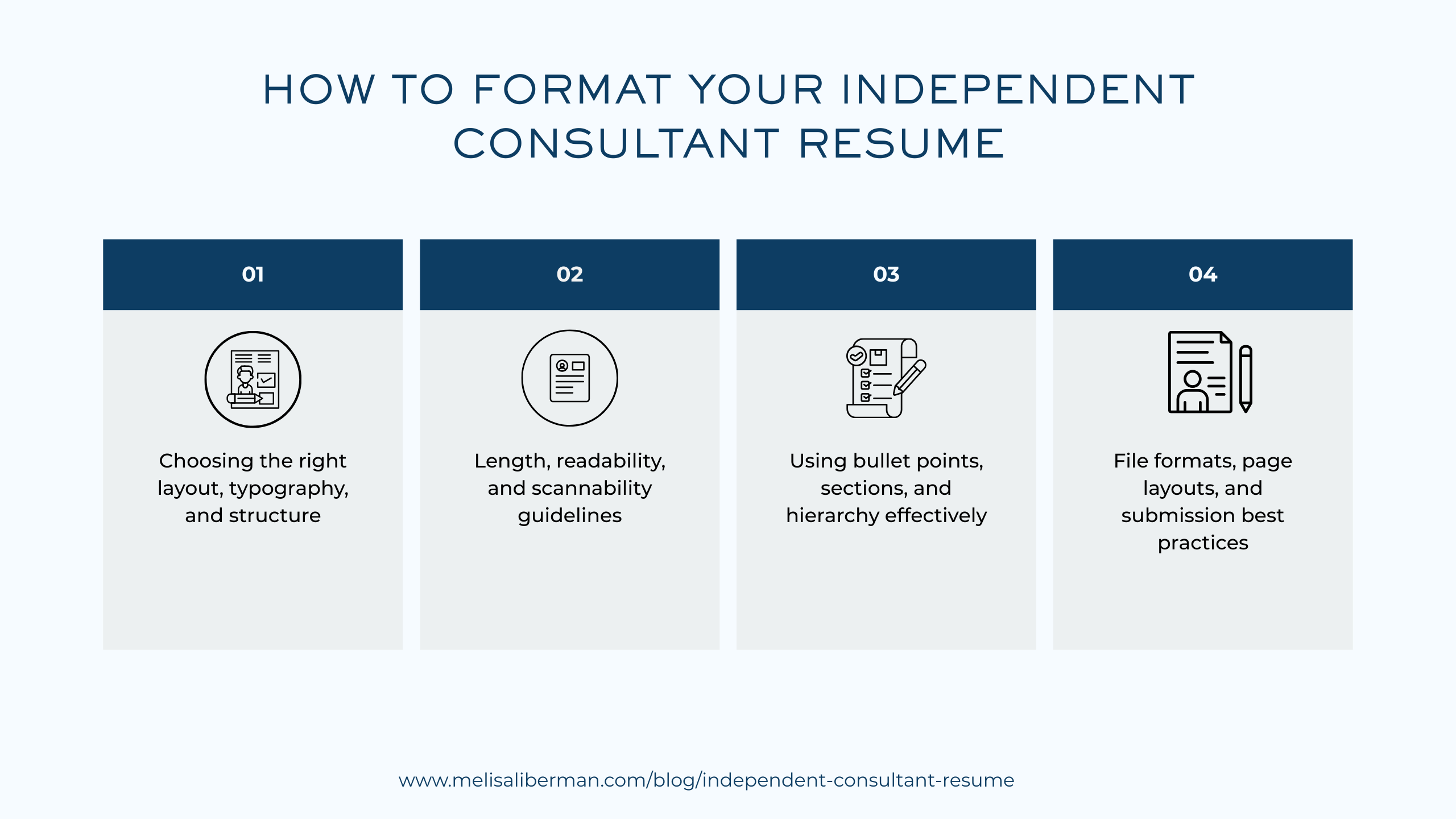
Choosing the right layout, typography, and structure
Prioritize readability. Use clear section headers, consistent font choices, and balanced white space.
Visual flow helps reviewers find what they need quickly.
Length, readability, and scannability guidelines
One to two pages is standard. Use bullet points and concise language.
If it feels dense, it is too long.
Using bullet points, sections, and hierarchy effectively
Structure content hierarchically. Lead with the most relevant information and support it with concise detail.
File formats, page layouts, and submission best practices
PDF is usually safest. Ensure the layout is ATS compatible, email-ready, and mobile-friendly.
Avoid overly complex designs that break in different systems.
Independent consultant resume template (free download)
A well-designed template can save time and reduce formatting errors.
This template is structured for project-based consulting work and outcome-focused positioning.
Why this template works
It prioritizes client focus, clear structure, and impact storytelling. The layout supports quick scanning and credibility assessment.
How to customize it for your brand and niche
Adjust keywords, tone of voice, and emphasis based on your niche. Keep visual elements minimal and professional.
Independent consultant resume examples (good vs. bad)
Examples clarify what works and what undermines credibility.
Comparing good and bad resumes highlights the importance of focus and clarity.
Good example: strengths, structure, and clarity
Strong examples feature clear headings, measurable results, focused messaging, and consistent formatting.
They make the consultant’s value easy to understand.
Bad example: what doesn’t work and why
Poor examples rely on generic content, cluttered design, and vague role descriptions.
They read like employee resumes and fail to communicate consulting value.
Common mistakes to avoid on your independent consultant resume
Common mistakes include vague language, no results, excessive detail, and generic summaries.
Most stem from employee thinking rather than consulting reality.
Frequently asked questions about independent consultant resumes
These are common concerns among experienced consultants navigating documentation requirements.
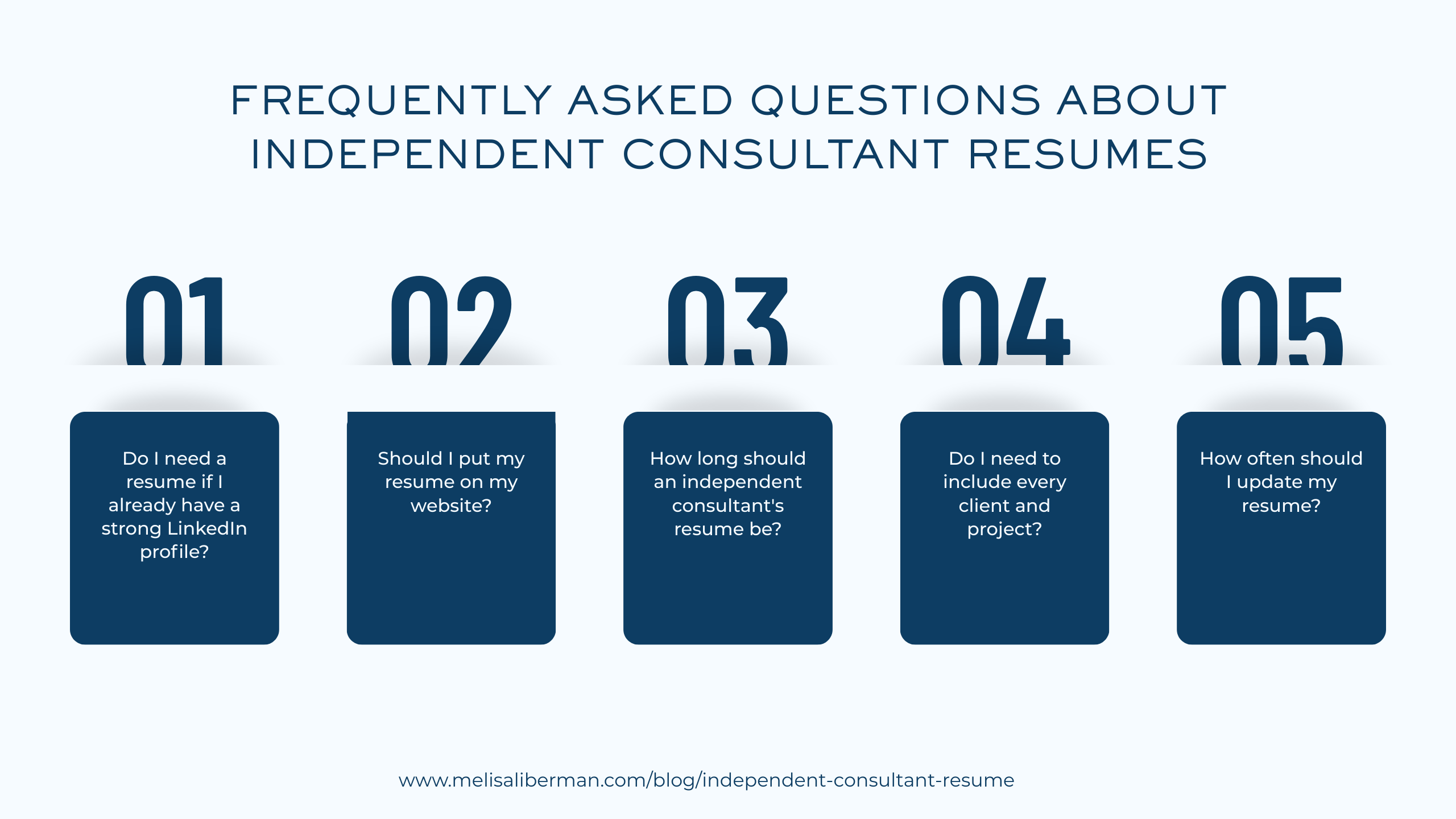
Do I need a resume if I already have a strong LinkedIn profile?
LinkedIn and resumes serve different purposes. LinkedIn supports discovery and authority. Resumes support documentation when required.
They are complementary, not interchangeable.
Should I put my resume on my website?
Generally, no. A public resume can undermine positioning.
A capability deck or case-based page is usually more effective. If you include a resume, keep it gated or context-specific.
How long should an independent consultant's resume be?
One to two pages is typical. Prioritize relevance over completeness.
Do I need to include every client and project?
No. Select projects that reinforce your positioning and target audience.
Relevance matters more than volume.
How often should I update my resume?
Quarterly updates work well. Track projects as they close to avoid reconstruction later.
Get expert help building a strong consultant brand and pipeline
Resumes are only one small part of a consulting business.
Many solo consultants struggle not because their resume is weak, but because their positioning, authority, and pipeline are underdeveloped. Shifting from employee thinking to ownership requires intentional brand and offer design.
Programs like private coaching using my IC-Grow Framework and my Consultant’s Lead Gen Sprint help consultants build sustainable pipelines, clear positioning, and marketing assets that actually drive demand. If you want support designing assets that sell outcomes instead of credentials, explore your next step or book a consultation.

About